The Asian Development Bank has lowered Nepal’s 2026/27 growth forecast to 4.1 percent, citing economic disruption from the Bhotekoshi floods and higher reconstruction-related costs.
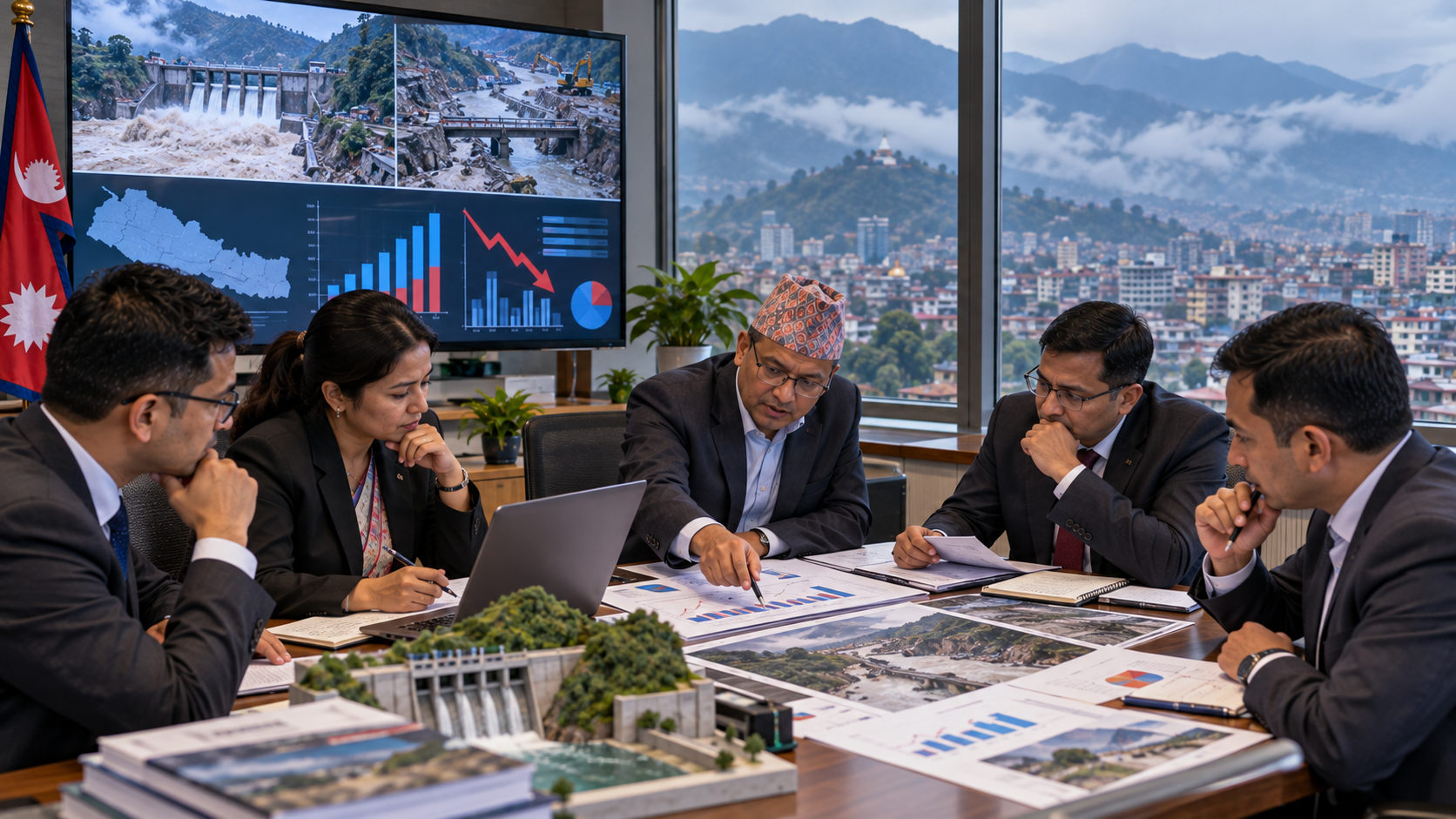
The Asian Development Bank (ADB) has lowered its economic growth forecast for Nepal for fiscal year 2026/27, citing the disruption caused by the devastating Bhotekoshi floods and damage to transport, hydropower and other productive infrastructure.
In its September 2026 Asian Development Outlook, the multilateral development bank reduced Nepal’s projected growth to 4.1 percent, down 0.4 percentage point from its July forecast of 4.5 percent. The current fiscal year ends in mid-July 2027.
The August 26 disaster damaged roads, bridges, hydropower facilities, homes and other infrastructure across affected areas.
The ADB expects these disruptions to weigh on industrial and services activity, particularly during the early part of the fiscal year. Damage to transport networks and productive assets has also disrupted trade, tourism, agriculture and local economic activity.
At the same time, reconstruction and rehabilitation spending could partially offset the economic slowdown by generating demand for construction materials, labour, transportation and related services.
The government’s preliminary assessment has estimated that Rs723.31 billion will be required to rebuild infrastructure damaged by the floods.
The ADB has also raised its inflation forecast for Nepal to 5.3 percent for 2026/27.
The bank expects supply disruptions caused by the floods to put upward pressure on food and other essential goods, while damaged transport infrastructure could increase logistics costs.
Reconstruction activity is expected to create additional demand for construction materials, transport services and labour. Higher international fuel prices linked to the conflict in West Asia could add further cost pressures.
Nepal's inflation averaged 3.1 percent in the previous fiscal year, according to the ADB outlook, with food inflation at 1.1 percent and non-food inflation at 4.2 percent.
The post-flood reconstruction effort is also expected to increase pressure on government finances.
Nepal's fiscal deficit stood at an estimated 3 percent of GDP in 2025/26. The ADB projects it could widen to 4.7 percent of GDP in 2026/27, compared with a pre-disaster projection of 3.4 percent.
Public debt was estimated at 44.9 percent of GDP at the end of the previous fiscal year and is expected to rise further as additional resources are mobilised for reconstruction and recovery.
Despite the expected increase in financing requirements, the ADB continues to assess Nepal as being at low risk of debt distress.
The floods have also affected Nepal's electricity generation infrastructure.
According to the ADB report, more than 430 megawatts of electricity-generation capacity were forced out of the grid following the disaster, equivalent to around 10 percent of Nepal's installed generation capacity of 4,296 MW.
The damage is also expected to limit Nepal's electricity export potential during the current fiscal year.
Energy Minister Biraj Bhakta Shrestha told Parliament that restoring damaged hydropower, irrigation and river-control infrastructure could cost around Rs400 billion.
Tourism has also been affected by damaged roads and infrastructure.
A Nepal Tourism Board assessment cited by the Kathmandu Post estimated preliminary tourism-sector economic losses from the August 26 floods and subsequent landslides at Rs52.67 billion.
The closure of the Prithvi Highway following the Krishnabhir landslide disrupted transportation between Kathmandu and Pokhara and left around 150 tourist buses serving the route idle for 18 days.
The ADB expects tourism arrivals to recover gradually in 2027 as transportation and other infrastructure are restored.
Despite the disaster-related pressures, Nepal enters the period with a relatively strong external position.
The ADB reported that remittances and exports helped Nepal record a current-account surplus equivalent to 14 percent of GDP in 2025/26, while the overall balance of payments recorded a surplus of 15.6 percent.
Foreign-exchange reserves reached a level equivalent to more than 19 months of imports, giving the country a significant external buffer as reconstruction and import demand increase.
The ADB also expects stronger domestic demand and reconstruction activity to increase imports, which could narrow the current-account surplus while leaving Nepal's external position relatively comfortable.
The downgrade does not mean that reconstruction will have only negative economic effects.
Economist Chandra Mani Adhikari told the Kathmandu Post that faster reconstruction could increase demand for cement, steel, food, fuel, transportation and other services.
However, he cautioned that a reconstruction-driven acceleration in economic activity would not necessarily represent sustainable long-term growth.
The government has set a 6 percent annual growth target, meaning the ADB's 4.1 percent projection remains substantially below the government's objective.
For Nepal, the economic challenge now involves both restoring damaged infrastructure and maintaining investment, production and employment while reconstruction proceeds.
Comments
0 comments
Loading comments...