The Bhote Koshi flash flood has exposed vulnerabilities in Nepal’s disaster preparedness, infrastructure and settlement planning. Recovery should go beyond replacing damaged structures and focus on safer communities, livelihoods, accountability and climate resilience.
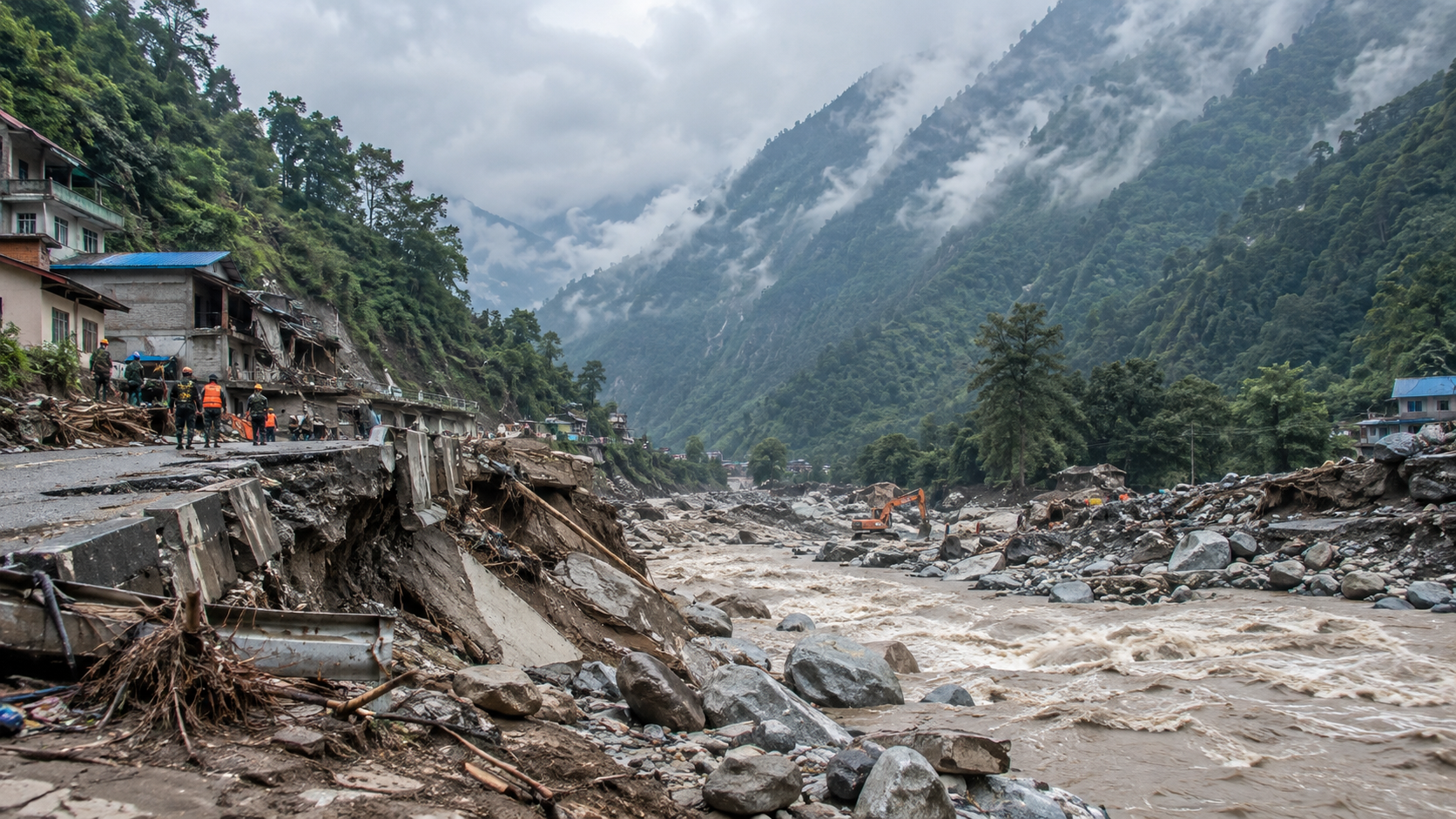
The devastating flash flood that struck the Bhote Koshi River region on August 26 has left Nepal facing a difficult transition from emergency response to long-term recovery. The disaster caused extensive loss of life and widespread damage to homes, roads, bridges, hydropower facilities and other infrastructure, particularly across areas downstream of the affected river system. Nepal’s authorities have continued search, rescue and relief operations since the disaster.
But once immediate rescue operations subside, the larger challenge will begin: how Nepal rebuilds communities that have been exposed to extreme natural hazards.
The debate should not be limited to how quickly damaged roads, bridges and buildings can be reconstructed. It should also ask why some communities were so vulnerable in the first place and whether reconstruction could unintentionally recreate the same risks.
The Bhote Koshi disaster demonstrates that disaster management cannot end with rescue and relief.
Survivors may lose much more than houses or physical property. Damage to schools, health facilities, businesses, agricultural assets, documents and transport links can disrupt livelihoods and access to essential public services for months or even years.
Nepal's Ministry of Home Affairs has already stressed the importance of both moving survivors to safety and arranging their longer-term rehabilitation.
That means recovery should be understood as a continuous process: saving lives, providing relief, restoring livelihoods, rebuilding essential infrastructure and reducing the possibility of another disaster.
One of the most important lessons from the flood is the need to reconsider where and how critical infrastructure is built.
Homes, schools, health facilities, roads and other essential services located close to vulnerable river corridors or unstable slopes can face enormous risks during extreme events. Reconstructing them in exactly the same locations without reassessing those risks could leave communities exposed again.
A more resilient approach would combine updated hazard mapping, land-use planning, stronger building standards, improved drainage and river management, and protection of natural systems that can reduce flood impacts.
This does not mean that every community can simply be relocated. Resettlement can affect livelihoods, social networks, cultural ties and access to land. Decisions therefore need to involve affected communities rather than being imposed without meaningful consultation.
The disaster has also renewed questions about monitoring and early-warning systems.
The precise chain of events behind the August 26 flood has been the subject of scientific investigation. Nepal's health authorities describe the event as following an ice and rock avalanche and temporary damming of the Lhende Khola north of the border. Independent reporting has also pointed to a possible glacier-related trigger and examined the influence of warming conditions.
Regardless of the final scientific assessment, the practical lesson is clear: communities exposed to sudden floods need warnings that are timely, understandable and actionable.
An early-warning system is useful only when information travels from monitoring stations to local authorities and, ultimately, to people who can evacuate. Warning systems should therefore be accompanied by clearly identified evacuation routes, shelters, communication networks and regular community preparedness exercises.
For many affected families, the economic consequences of a disaster can continue long after floodwaters disappear.
A destroyed shop can mean the loss of income. Damaged agricultural equipment can prevent a farmer from returning to production. The destruction of transport infrastructure can isolate communities from markets, schools and health services.
For this reason, compensation and rehabilitation should consider livelihood losses alongside physical damage.
Recovery programmes should also be accessible to people who may face additional barriers, including older people, persons with disabilities and households that have lost essential documentation during the disaster.
Transparent procedures are equally important. Survivors should know what assistance is available, who qualifies and how decisions are made.
The Bhote Koshi disaster has also intensified discussion about Nepal's vulnerability to climate-related hazards.
Nepal contributes only a small share of global greenhouse-gas emissions while remaining highly exposed to climate risks in its mountains and river systems. Scientific research has linked warming conditions in the Himalayas with changes in glaciers, precipitation and the risks associated with floods and landslides.
However, climate change should not become an explanation that removes responsibility for local preparedness.
Extreme natural events can become humanitarian disasters when vulnerable settlements, inadequate infrastructure, weak preparedness and limited warning capacity combine with hazardous conditions.
That is why climate resilience must be integrated into development planning rather than treated as a separate environmental issue.
Large dams and reservoirs may form part of Nepal's long-term flood-management strategy in some river basins, while also contributing to electricity generation, irrigation and water storage.
But they cannot be regarded as a universal solution to flood risk.
Any major dam or reservoir project would require rigorous assessment of geology, sedimentation, environmental impacts, downstream risks, seismic conditions and dam safety. Nepal's complex mountain terrain makes it especially important to assess each project according to the characteristics of its river basin.
Flood management should therefore combine engineering with nature-based approaches, forecasting, hazard mapping, land-use planning and community preparedness rather than relying on a single intervention.
The most important principle for Nepal's recovery should be that affected people are not merely recipients of relief; they are rights-holders whose lives and livelihoods must be restored with dignity.
Reconstruction should consider access to housing, education, healthcare, food, water, employment, security and essential documentation.
Affected communities should also have a meaningful role in decisions about relocation, infrastructure design and livelihood restoration.
This is particularly important because disasters can deepen existing inequalities. A recovery programme that benefits only those who can navigate complex administrative systems or prove ownership of formal property could leave vulnerable households behind.
The government has estimated preliminary losses from the August 26 disaster at roughly Rs 387.54 billion, highlighting the enormous economic scale of the catastrophe. A detailed assessment is still required.
That scale of damage makes rebuilding an enormous national undertaking. It is also an opportunity to reconsider how Nepal prepares for future disasters.
The objective should not simply be to restore what existed before August 26. Nepal should aim to create communities that are safer, better prepared and better equipped to recover when the next extreme event occurs.
The Bhote Koshi flood cannot be undone. But the recovery that follows can determine whether it becomes only a devastating chapter in Nepal's history or a turning point in how the country approaches disaster preparedness, climate resilience and development.
Rebuilding with resilience means more than stronger concrete and wider roads. It means better information, safer planning, stronger institutions, protected livelihoods and meaningful participation by the people whose lives are most directly affected.
That is ultimately what building back better should mean for Nepal: not simply rebuilding what was lost, but reducing the risk of losing it again.
Comments
0 comments
Loading comments...