Flydubai’s daily Pokhara-Dubai service opens a new international connection for Nepal’s tourism capital, but passenger demand, road access and supporting services will determine whether the route can continue beyond its initial schedule.
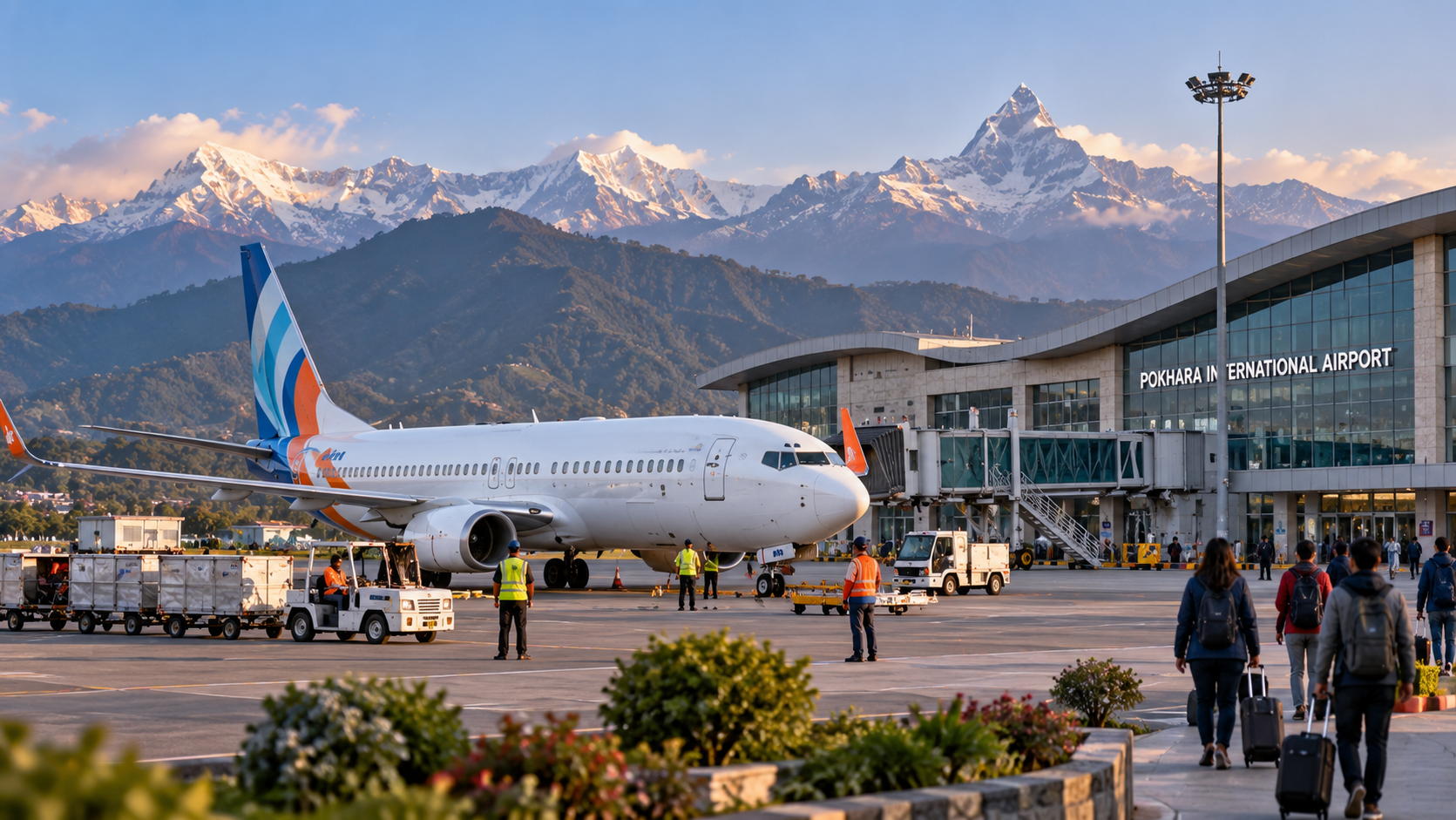
Flydubai has begun daily scheduled flights between Dubai and Pokhara, giving Nepal’s tourism capital a direct international air connection and providing a new test for the country’s efforts to make its newer international airports commercially sustainable.
The Dubai-based airline’s first scheduled service to Pokhara began on September 23. Under Nepal’s approved summer schedule, the airline is authorised to operate one flight a day on the Dubai-Pokhara-Dubai route through October 24.
For Pokhara, the arrival of a regular foreign carrier is an important development. But the experience of Gautam Buddha International Airport in Bhairahawa shows that securing an international route is only the beginning. The longer-term challenge is generating enough passenger demand and supporting services to keep airlines operating.
Flydubai becomes the first UAE-based airline to operate a direct service to Pokhara International Airport. The airline has been serving Kathmandu since 2009, making Pokhara its second destination in Nepal.
The route is being operated as part of Flydubai’s codeshare partnership with Emirates. This gives passengers access to connections through Dubai and a wider combined network.
Flydubai's published schedule lists flight FZ1165 from Dubai to Pokhara and FZ1166 for the return sector. The Dubai-Pokhara flight is scheduled to arrive at 6:15pm, with the return departure at 7:15pm local time.
The route therefore provides more than a direct connection with the UAE. Dubai's role as an international aviation hub potentially gives travellers from other markets another way to reach Pokhara.
The new scheduled service is not Pokhara's first experience with international aviation.
Himalaya Airlines previously operated scheduled flights between Pokhara and Lhasa, China. That service was later withdrawn after passenger numbers were insufficient to make the route financially sustainable, according to OnlineKhabar.
Pokhara has also received international charter flights. More than two dozen charter flights operated by Sichuan Airlines from China arrived before the start of the Flydubai service, while charter operations from Bhutan have also been reported.
Those experiences indicate that international flights can reach Pokhara. The more difficult question is whether scheduled services can consistently attract enough passengers.
Gautam Buddha International Airport in Bhairahawa experienced a temporary increase in international activity when maintenance at Tribhuvan International Airport restricted operating hours in Kathmandu.
Several airlines, including Flydubai, Jazeera Airways, Nepal Airlines, Qatar Airways and Thai AirAsia, shifted some operations to Bhairahawa during that period.
When work at Tribhuvan International Airport was completed in March, airlines returned to Kathmandu and international activity at Bhairahawa subsequently declined.
The experience illustrates the difference between temporary traffic and a durable route network.
Former Nepal Tourism Board chief executive Deepak Raj Joshi told OnlineKhabar that international airports require cooperation among government agencies, airlines and tourism businesses. He also pointed to the importance of having sufficient passenger demand rather than relying only on infrastructure.
Air connectivity does not operate independently of ground transportation.
OnlineKhabar's report highlights poor road access as one factor that complicated efforts to build sustained demand for Bhairahawa. For Pokhara, reliable road connections with other parts of Nepal could similarly influence the size of the airport's potential passenger market.
Travellers arriving at Pokhara from abroad may include tourists heading into the Annapurna region, business travellers and Nepalis travelling between overseas destinations and western or central parts of the country.
Making those journeys convenient requires more than an international terminal. Roads, ground transport, tourism services and efficient airport procedures all contribute to whether passengers choose a particular gateway.
The Pokhara-Dubai route has one feature that distinguishes it from some of the airport's earlier international services: Dubai is a major international transit hub.
Flydubai says its Pokhara service is designed to provide connections for travellers from the Gulf, wider Middle East and Europe, as well as other markets through its network and partnerships.
That does not guarantee high passenger loads. Demand will ultimately depend on fares, schedules, tourism flows, migrant-worker travel, connecting opportunities and the convenience of travelling through Pokhara rather than Kathmandu.
The airline's initial approval through October 24 also means the early months of operation will provide an important indication of passenger demand.
An international flight is only useful to passengers if the rest of the journey can be completed efficiently.
Former Civil Aviation Authority of Nepal deputy director general Devanand Upadhyay told OnlineKhabar that passengers should not have to travel to Kathmandu for documentation or other services after arriving at Pokhara. He argued that such gaps could undermine the convenience of using the international gateway.
Pokhara International Airport says it is equipped to provide immigration, customs and cargo services, while its official portal provides live flight information and airport service details.
The challenge is therefore increasingly about how these facilities, airlines, tourism businesses and government services work together.
Pokhara International Airport began operations in January 2023, but international scheduled services have remained limited. The Civil Aviation Authority of Nepal's international summer schedule for 2026 includes Flydubai among the approved international airlines.
The Flydubai service gives the airport a new opportunity to establish a more consistent international connection.
Whether that develops into a broader network will depend on passenger demand and the wider tourism and transport ecosystem.
For Nepal, the experience also offers a broader policy lesson: building international airport infrastructure and attracting an airline are separate stages of aviation development. Long-term viability requires airlines to find a sufficiently large market, while travellers need convenient roads, airport services, competitive schedules and reasons to use the route.
Flydubai's arrival marks the start of that process for Pokhara. The next measure will be how the route performs after the initial launch period and whether it creates conditions for additional international services.
Comments
0 comments
Loading comments...