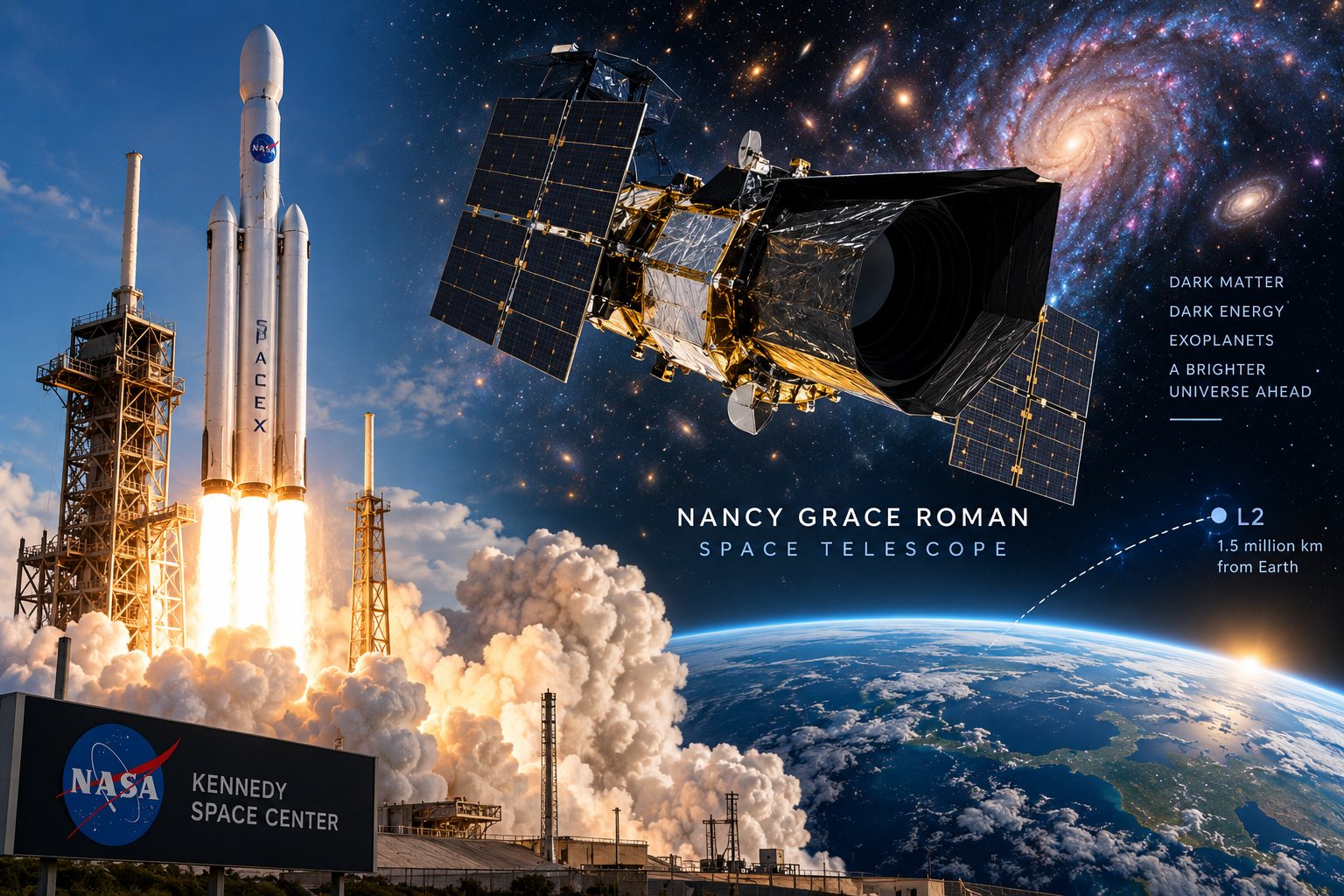
NASA has launched the Nancy Grace Roman Space Telescope, a powerful new observatory designed to investigate some of the biggest unanswered questions in astronomy, including the nature of dark matter, dark energy and planets beyond our solar system.
The telescope was launched on August 30 aboard a SpaceX Falcon Heavy rocket from NASA’s Kennedy Space Center in Florida. It is now travelling toward its destination near the Sun-Earth L2 point, roughly 1.5 million kilometres from Earth.
Roman is one of NASA’s most ambitious astrophysics missions. Built at a cost of about $4.3 billion, the telescope is designed to survey enormous areas of the sky rather than focus on small regions at a time.
NASA says Roman will have a field of view at least 100 times wider than Hubble's, allowing scientists to observe vast numbers of galaxies and stars in a relatively short period.
Its primary instrument is a 300-megapixel infrared camera capable of capturing wide cosmic panoramas. The telescope is designed to survey the universe about 1,000 times faster than Hubble, opening the possibility of discovering phenomena that have previously been difficult to detect.
One of Roman's central objectives is to improve scientists' understanding of dark matter and dark energy.
Dark matter cannot be directly observed with ordinary telescopes, but its gravitational effects can be detected through the way it influences galaxies and the large-scale structure of the universe.
Dark energy, meanwhile, is the name given to the mysterious component believed to be driving the accelerated expansion of the universe.
By mapping billions of galaxies and measuring how cosmic structures change and are distributed, Roman could provide scientists with new evidence about how the universe has evolved and what is driving its expansion.
Roman will also contribute to the search for exoplanets—planets orbiting stars beyond our Sun.
The telescope carries a Coronagraph Instrument, designed to block the intense light of stars so that comparatively faint objects orbiting them can be studied. NASA says the instrument will demonstrate technologies that could eventually help future missions directly image Earth-like planets and investigate whether they might be capable of supporting life.
Roman is expected to generate approximately 1.4 terabytes of scientific data every day, making it one of NASA's highest-data-rate astrophysics missions.
Artificial intelligence, machine learning and scientists will help process the enormous volume of information and identify potentially significant discoveries for further investigation.
Scientists expect the telescope to build a much broader picture of the universe by combining large-scale surveys with detailed observations of particular cosmic objects.
Following its launch, Roman successfully separated from the Falcon Heavy rocket and began its journey toward the second Sun-Earth Lagrange point, known as L2.
NASA says the telescope will spend about three months travelling and undergoing commissioning, including instrument checks and calibration. The first scientific images are expected to be released in early 2027.
Roman will complement rather than replace NASA's existing space telescopes. While Hubble and the James Webb Space Telescope can provide detailed observations of selected regions, Roman is designed to survey much wider portions of the sky.
Together, the observatories could give astronomers a more complete picture of cosmic history—from the evolution of galaxies and the expansion of the universe to the discovery of distant worlds.
HamroBichar will continue to follow major developments in space science, NASA missions and new discoveries about the universe.
Tags: NASA, Roman Space Telescope, Nancy Grace Roman, SpaceX, Dark Matter, Dark Energy, Exoplanets, Astronomy, Space Science, Universe
Comments
0 comments
Loading comments...