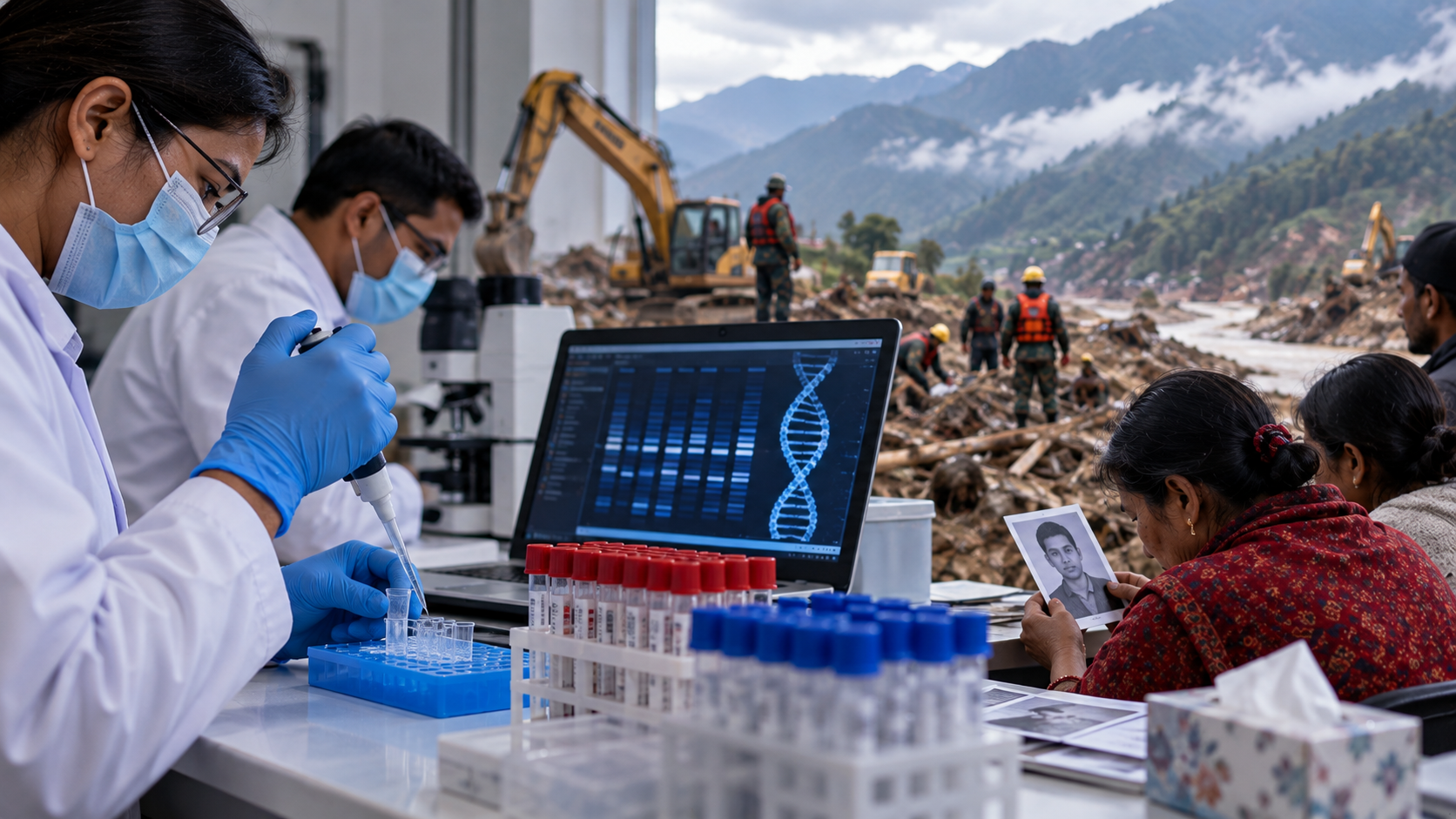
Nepal is facing a major forensic challenge in identifying victims of the devastating Bhotekoshi floods, with laboratories struggling to process an unprecedented number of DNA samples amid shortages of trained personnel, technology and essential laboratory supplies.
As of Sunday afternoon, 1,341 bodies had been recovered, but only 98 had been formally identified, according to Nepal Police figures reported by Kantipur. More than 2,000 DNA samples from recovered bodies and relatives of missing people have already reached Nepal's two principal forensic laboratories.
For thousands of families still searching for missing relatives, DNA testing has become one of the few remaining ways to establish what happened to their loved ones.
The scale of the disaster has placed unprecedented pressure on Nepal's forensic system.
The country has only two laboratories conducting DNA testing for such cases: the Nepal Police Central Forensic Science Laboratory and the National Forensic Science Laboratory under the Ministry of Science, Technology and Innovation.
Under normal circumstances, the two laboratories together processed fewer than 1,000 DNA samples annually. Following the Bhotekoshi disaster, more than 2,000 samples arrived almost simultaneously.
At the National Forensic Science Laboratory in Khumaltar alone, 530 samples involving recovered bodies and relatives had been received, according to senior scientific officer Mukul Pradhan.
The Nepal Police forensic laboratory had received 1,181 samples from bodies and partial remains and 1,186 samples from relatives, bringing its combined workload to more than 2,000 samples.
The crisis has exposed long-standing limitations in Nepal's forensic infrastructure.
DNA expert Dr Jeevan Rijal, a former head of the National Forensic Science Laboratory, said the number of specialists available at both laboratories is very low. The shortage of staff, combined with the cost and difficulty of obtaining laboratory reagents, has made the situation even more difficult.
The National Forensic Science Laboratory previously processed only around 40 to 45 DNA tests a month and about 350 a year, while the Nepal Police laboratory generally handled about 700 to 800 annually.
The current workload is therefore many times greater than the laboratories' normal capacity.
Recognising the limitations of Nepal's existing capacity, international assistance has begun arriving.
According to laboratory officials, 19 DNA experts from India and four from China are assisting the identification process. A 44-member disaster-response team from South Korea is also providing support.
Additional experts from Singapore and Japan have also been proposed.
Nepal has separately sought international assistance, including specialised DNA-testing equipment, as part of its wider response to the disaster. Reuters reported that DNA kits were among the equipment Nepal requested from the international community.
Identifying flood victims is particularly difficult because many bodies have remained underwater or buried in mud for extended periods.
Fresh blood samples can sometimes produce DNA results within one to two days. But when bodies have decomposed, forensic teams may need to extract DNA from teeth or bones.
According to forensic experts cited by Kantipur, DNA extraction from badly degraded bone samples has previously taken two to four months in some cases.
This means the condition of the remains can significantly affect how quickly a family receives an answer.
DNA identification requires comparison between genetic material recovered from a body and a reference sample from relatives.
For a missing child, samples can be collected from the mother or father. For a missing parent, children or a spouse can provide samples. If immediate relatives are unavailable, siblings may also be used.
Authorities have been collecting relatives' samples through district police offices and the Nepal Police Hospital in Kathmandu.
Relatives do not necessarily need to travel to the location where a body was recovered to provide a sample.
The huge number of recovered bodies has also created a separate logistical challenge.
Bodies have been recovered far downstream along the Trishuli and Narayani river systems, reaching districts including Nuwakot, Dhading, Tanahun, Gorkha, Chitwan and both Nawalparasi districts, with some remains reaching India. Chitwan alone had recorded 362 recovered bodies, while 222 were found along the Narayani River in eastern Nawalparasi.
With morgues unable to accommodate the growing number of bodies and prolonged exposure causing decomposition, authorities have begun carefully managing unidentified remains after completing postmortem examinations and collecting DNA samples.
Under Nepal's updated procedures, unidentified bodies are documented, assigned identification numbers and buried in sealed bags at designated locations. GPS coordinates and other records are maintained so that the remains can be recovered later if a DNA match is established.
In some locations, bodies and human remains have also been tagged and recorded with photographs and QR-based tracking information.
The identification process does not end when an unidentified body is buried.
Authorities say relatives can continue to submit claims, and if a DNA match is established, the remains can be recovered and handed over to the family.
Under the current arrangements, families can make claims for up to 12 years.
For families who have spent days searching hospitals, police offices and disaster zones, however, the waiting itself has become another form of suffering.
Police forensic officials estimate that, given the current workload, DNA identification could take at least three months. Additional technical support could reduce that timeframe.
The challenge is not simply the number of bodies. Search operations are still continuing, meaning more remains could be recovered and added to the already enormous workload.
For Nepal, the disaster has therefore exposed an urgent need to strengthen forensic capacity—not only for this crisis, but for future large-scale disasters.
The Bhotekoshi floods have demonstrated that disaster response does not end when survivors are rescued. For thousands of families, the final stage of the response is knowing the identity of those who never came home.
HamroBichar will continue to follow the victim-identification process, DNA testing efforts and the government's response to families affected by the Bhotekoshi disaster.
Tags: Bhotekoshi Flood, DNA Testing, Nepal Flood, Missing Persons, Victim Identification, Forensic Science, Nepal Police, Disaster Response, Rasuwa Flood
Comments
0 comments
Loading comments...