Nepali scientist Bishnu Bastakoti has built an international research career in nanomaterials and hydrogen energy, while continuing to seek stronger links between US and Nepali research institutions.
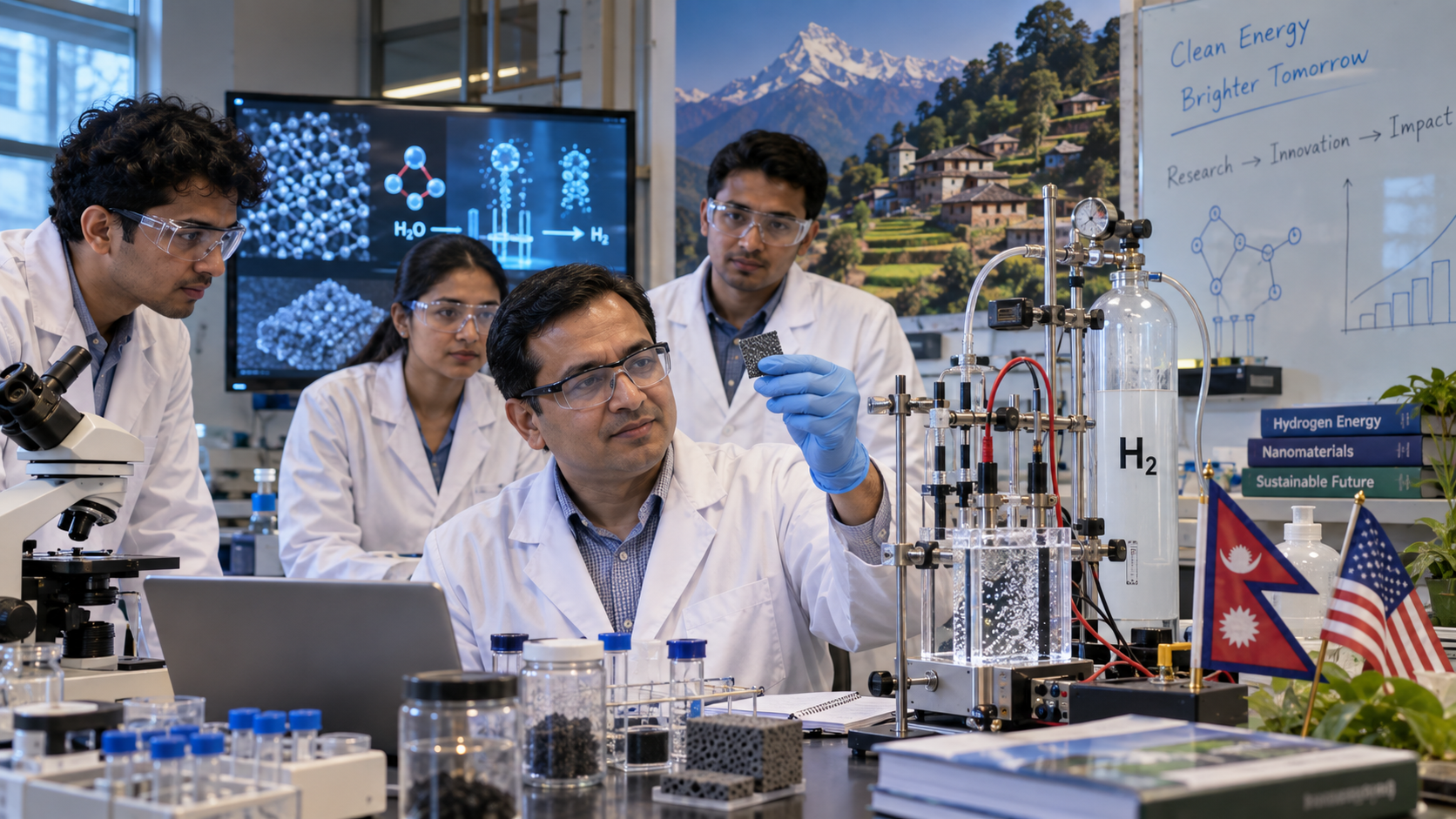
For Bishnu Bastakoti, the search for cleaner energy has a personal connection to the way his own education began.
Growing up in Aampipal, Gorkha, Bastakoti studied under the light of a kerosene lamp. Decades later, he is conducting research in the United States into nanomaterials and hydrogen technologies that could contribute to cleaner energy production.
Today, Bastakoti is an associate professor of chemistry at North Carolina Agricultural and Technical State University, where his research includes hydrogen production, nanomaterials and technologies for converting carbon dioxide into useful chemicals and fuels.
Bastakoti grew up in a farming family in Gorkha, where attending school involved long walks and helping with household and agricultural work.
After completing his School Leaving Certificate in 1995, an opportunity to study at SOS School in Pokhara changed his academic direction. He received a full scholarship and subsequently pursued science.
He completed higher secondary education, earned a bachelor's degree from Birendra Multiple Campus in Bharatpur and later completed a master's degree in chemistry at Tribhuvan University Central Campus in Kirtipur in 2004.
He initially entered teaching, working at private colleges in Kathmandu. The experience eventually strengthened his interest in advanced study and scientific research.
In 2008, Bastakoti received the Japanese government's Monbukagakusho scholarship to pursue a PhD at Saga University.
His doctoral work focused on polymers and nanomaterials and their applications in energy. After completing his doctorate, he received a Japan Society for the Promotion of Science fellowship and conducted research at Japan's National Institute for Materials Science.
He later worked as a research associate at the University of Sydney before joining Harvard University as a research associate.
His career subsequently took him to North Carolina A&T, where he established his own research programme.
Hydrogen is increasingly studied as a potential clean-energy carrier, but producing it economically remains a major scientific and engineering challenge.
Bastakoti's research focuses partly on developing nanostructured materials that can improve chemical processes involved in hydrogen production.
In 2024, Bastakoti and researcher Moses D. Ashie published research on a mesoporous honeycomb iron-titanate photocatalyst for hydrogen evolution through water splitting. The study explored how a highly porous structure could provide more active sites and improve charge transfer during the process.
North Carolina A&T reported in 2025 that Bastakoti and his team had developed a honeycomb-structured material that produced nearly twice as much hydrogen as a commercially available material in their experiments. The university described the work as part of efforts to develop more efficient materials for renewable hydrogen production.
Bastakoti has also emphasised that laboratory advances still need to be translated into affordable and practical technologies before hydrogen can become widely accessible.
According to the university information cited by OnlineKhabar, Bastakoti is involved as a principal investigator or co-principal investigator in around 15 research grants, with approximately $15 million in research funding from organisations including the US National Science Foundation, Department of Energy and National Institutes of Health.
His broader research programme includes nanomaterials, catalysis, energy conversion and processes involving carbon dioxide.
His research profile also extends beyond hydrogen. Recent scientific publications list him as a researcher in areas including electrocatalytic water splitting and nanostructured materials for energy and environmental applications.
Despite building his academic career overseas, Bastakoti has maintained links with Nepal's scientific community.
He has collaborated with the Nepal Chemical Society and helped organise international scientific conferences in Kathmandu. He has also worked with Tribhuvan University's Department of Chemistry to co-supervise PhD researchers.
His connection with Nepal's hydrogen-energy discussion became particularly visible in 2024, when the Nepal Forum of Science Journalists invited him to speak at its “Meet the Scientist” programme in Kathmandu.
At the event, Bastakoti discussed both the opportunities and challenges associated with hydrogen energy in Nepal, including the importance of renewable resources, infrastructure and economic conditions.
His research group has also begun collaborating with researchers at Kathmandu University working on hydrogen energy.
Bastakoti's interest in energy is closely connected to his childhood experience.
His early education took place during a period when electricity access in rural Nepal was limited, and kerosene lamps were part of everyday life.
Years later, one of his American students travelled to Nepal and experienced power cuts during a visit. The experience prompted the student to think about alternative energy sources.
For Bastakoti, the story created an unusual connection between his past and his scientific work.
The problems that scientists study can often originate in ordinary experiences: an electricity outage, an expensive fuel source or the environmental consequences of conventional energy production.
Bastakoti says he wants his experience to benefit researchers and students in Nepal as well as his work in the United States.
Greater collaboration between Nepali universities and international research institutions could provide opportunities for joint research, postgraduate supervision, laboratory development and knowledge exchange.
His work demonstrates one route through which researchers from Nepal's academic community can become part of international scientific networks while maintaining links with institutions and researchers at home.
For Bastakoti, the long journey from a village classroom in Gorkha to laboratories in Japan, Australia, Harvard and the United States has also shaped a broader goal: making scientific knowledge useful beyond the laboratory.
The challenge now is not simply producing hydrogen under controlled conditions, but finding materials, processes and systems that can eventually make cleaner energy technologies more practical and accessible.
Comments
0 comments
Loading comments...