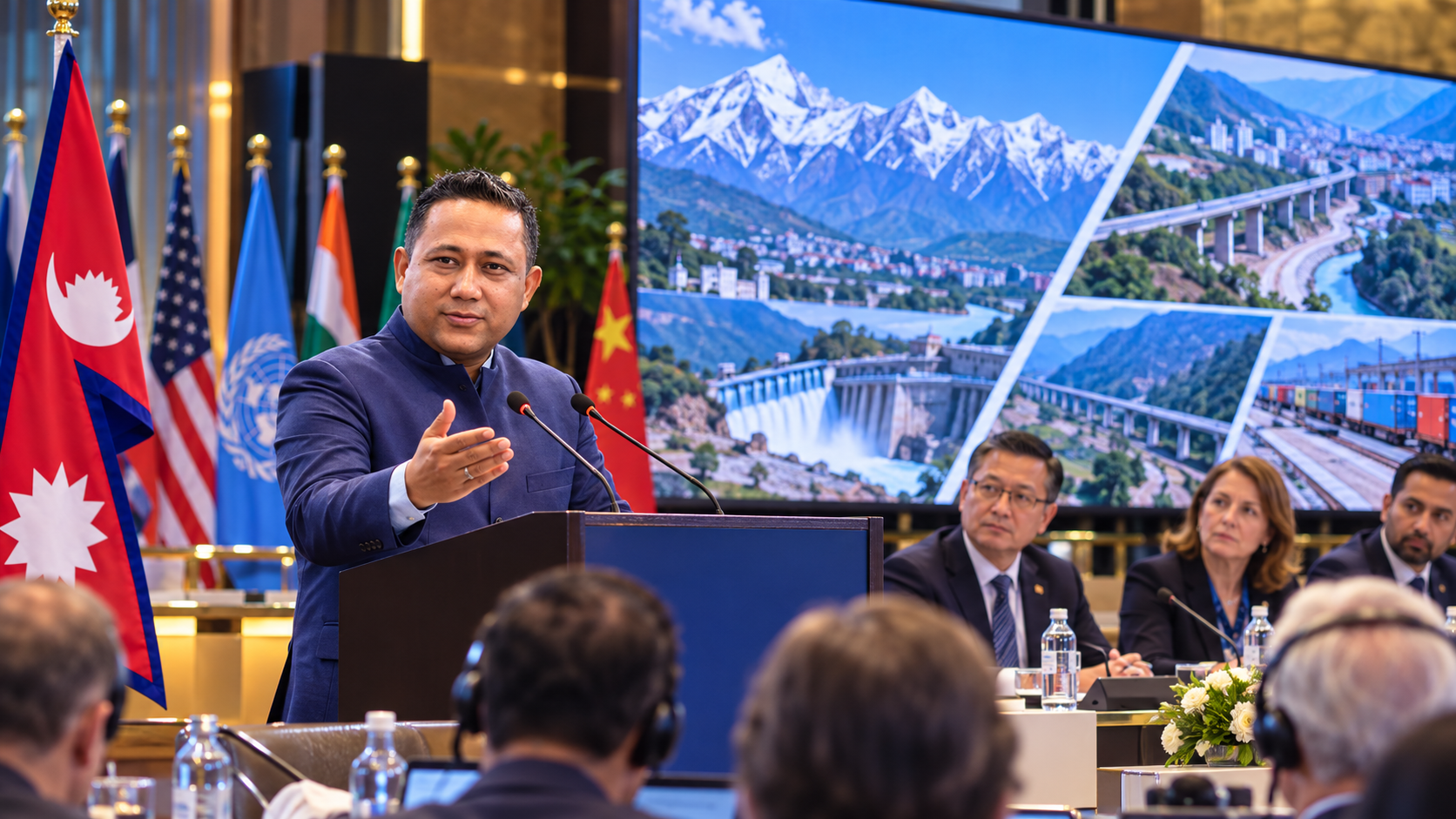
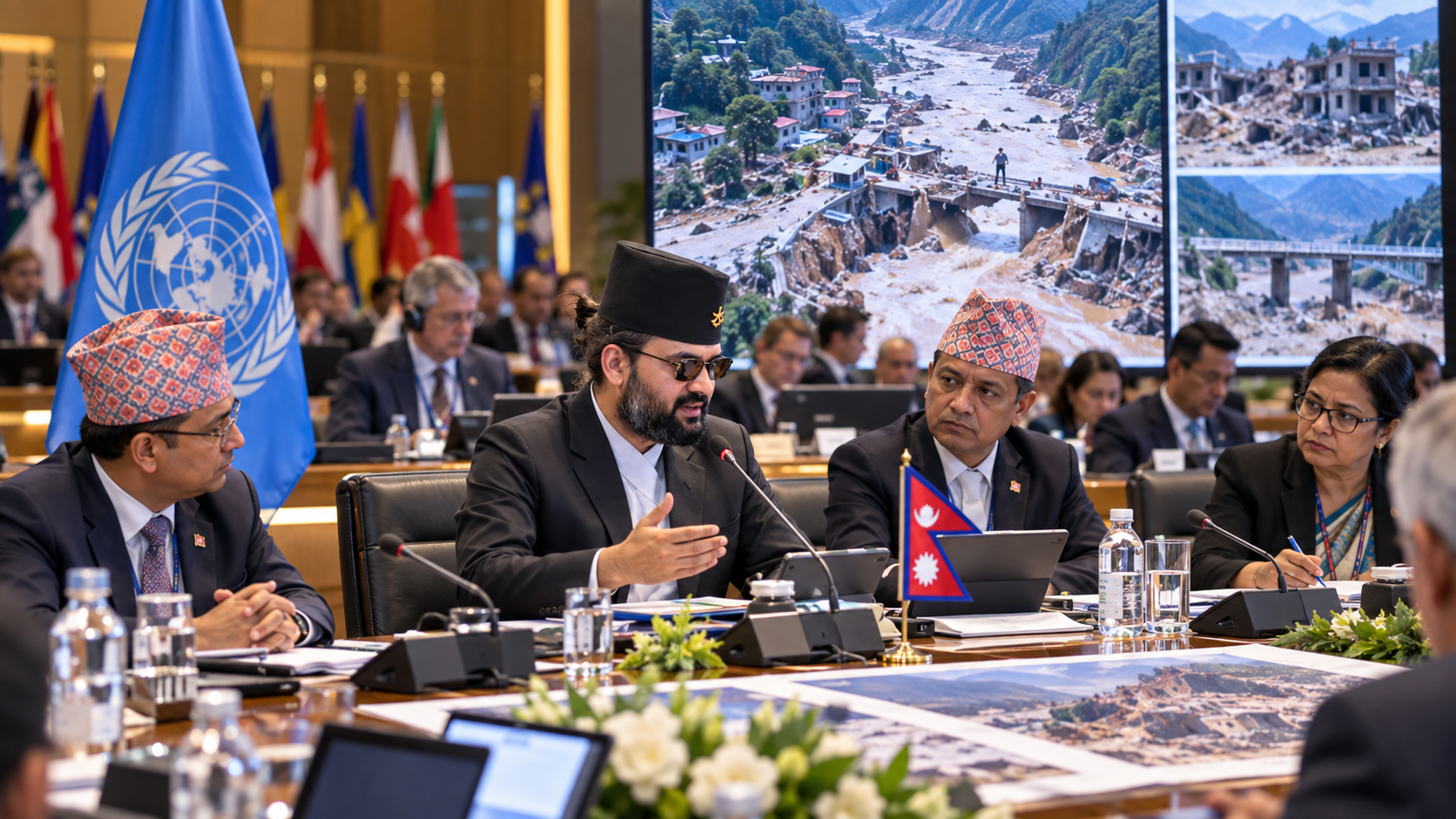
Prime Minister Balendra Shah used Nepal’s UN General Assembly address to highlight the Bhotekoshi-Trishuli disaster and call for climate finance, compensation, technology and stronger Himalayan cooperation.
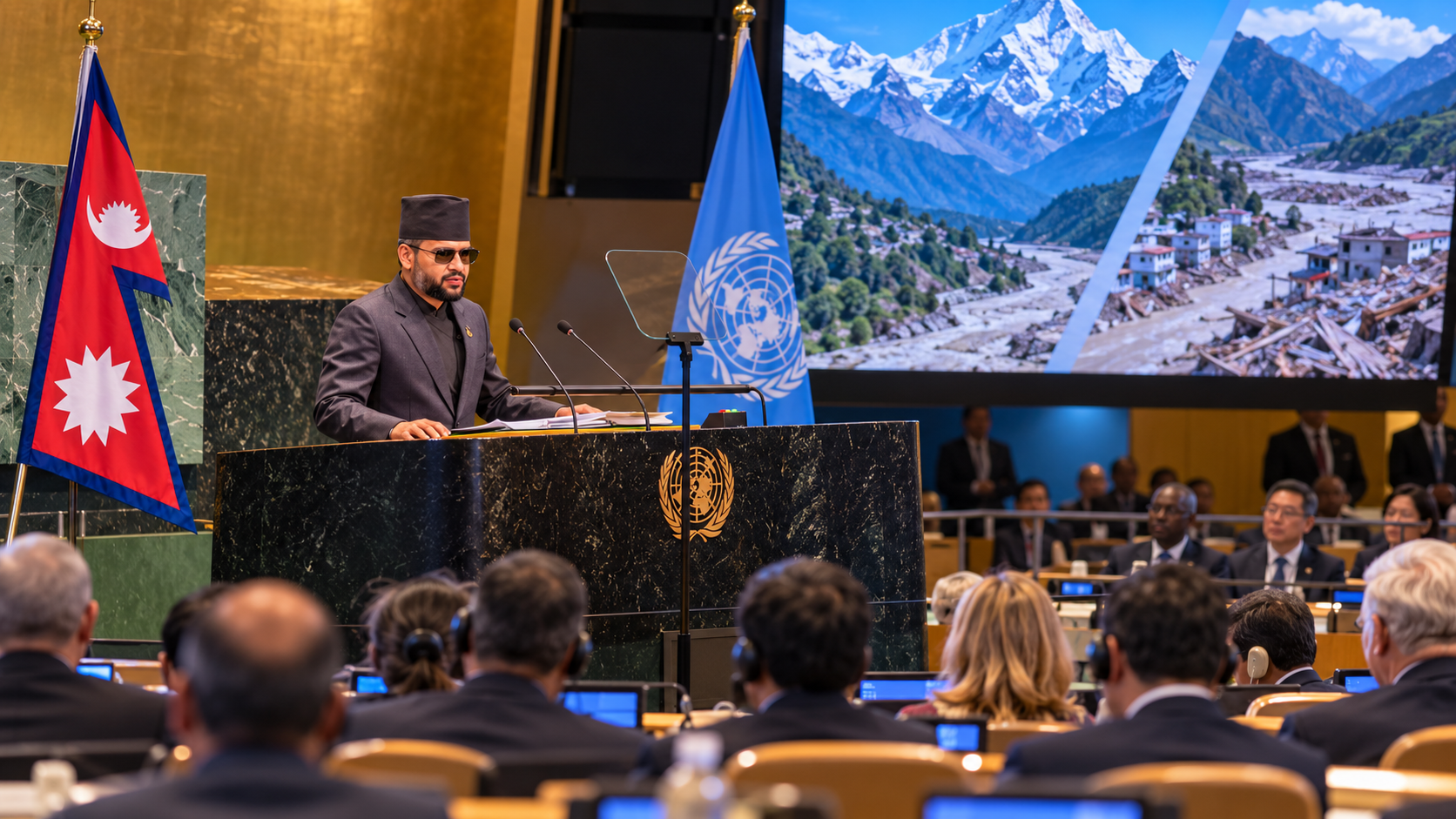
Prime Minister Balendra Shah used his address to the 81st United Nations General Assembly to place Nepal’s climate vulnerability, the recent Bhotekoshi-Trishuli disaster and the need for stronger international support at the centre of his message.
Shah addressed the General Assembly on September 24, following preparations that had identified climate justice, climate finance, technology transfer and disaster resilience as key priorities for Nepal. The government had said ahead of the visit that it would seek greater international support for recovery and climate-resilient development.
In his speech, Shah described the August disaster in Nepal as more than a domestic tragedy. He presented the Bhotekoshi-Trishuli floods as a warning about the risks faced by Himalayan communities as the climate changes.
He said Nepal contributes less than 0.1 percent of global greenhouse-gas emissions while facing severe consequences from a warming climate, including glacier retreat, unstable mountain slopes, unpredictable rivers and repeated damage to infrastructure and livelihoods.
The prime minister linked the disaster to a wider need to strengthen preparedness rather than relying mainly on emergency responses after disasters occur.
A central element of Shah’s message was Nepal’s demand for increased financial and technological support.
He called for adequate grant-based assistance and argued that existing international climate-financing mechanisms are insufficient for countries facing severe climate impacts. He also highlighted the need for financing that can be accessed without lengthy administrative procedures.
Before Shah’s address, Nepal’s Foreign Ministry had said the country would appeal to developed nations for accessible and concessional climate finance and technology for climate-resilient infrastructure, climate-smart agriculture, disaster preparedness and institutional capacity building.
Shah also proposed establishing a Himalayan Climate Resilience Mechanism involving Nepal, India and China.
The proposed mechanism would focus on sharing satellite information and technical expertise, monitoring dangerous glacial lakes, strengthening early-warning systems and coordinating disaster response across borders.
The proposal reflects Nepal’s argument that climate-related hazards in the Himalayas do not stop at national boundaries. Shah noted that floods and other hazards can affect communities across Nepal, China and India, making regional cooperation important for disaster preparedness and response.
Shah framed Nepal’s climate demands around six concepts: relief, rehabilitation and reconstruction, alongside responsibility, reparation and resilience.
He argued that recovery from climate-related disasters should not leave vulnerable countries repeatedly borrowing to rebuild infrastructure damaged by events they contributed little to causing.
The speech also called for stronger early-warning systems, resilient infrastructure, insurance, innovation and reduced dependence on fossil fuels.
Shah also pointed to Nepal’s own environmental efforts, including forest restoration, hydropower development, electric mobility and local climate-adaptation measures.
The argument was that Nepal is taking steps to limit environmental damage while simultaneously facing significant climate risks.
The government had similarly planned to highlight Nepal’s forest coverage, Himalayan ecosystems and river systems during the UN meetings as part of its climate diplomacy.
The prime minister connected climate justice with broader questions about international cooperation and the global economic order.
He argued that climate justice involves not only financial assistance but also questions of who bears the costs of climate impacts, who participates in decision-making and whether vulnerable countries have a meaningful voice in international institutions.
Shah also reaffirmed Nepal’s support for multilateralism and called for a United Nations in which smaller and poorer countries can have greater influence over global decisions.
Shah’s UN appearance came during Nepal’s broader diplomatic effort to secure international attention for the consequences of the Bhotekoshi-Trishuli disaster and the country’s longer-term recovery requirements.
The government is also hosting the “Sagarmatha to the Sea: A Call to Action for a Climate-Resilient Future” side event on September 25, continuing its effort to put mountain climate risks and resilience on the international agenda.
For Nepal, the UN platform has therefore become an opportunity not only to seek immediate recovery assistance but also to argue for stronger international mechanisms for climate finance, technology, early warning and Himalayan cooperation.
Comments
0 comments
Loading comments...