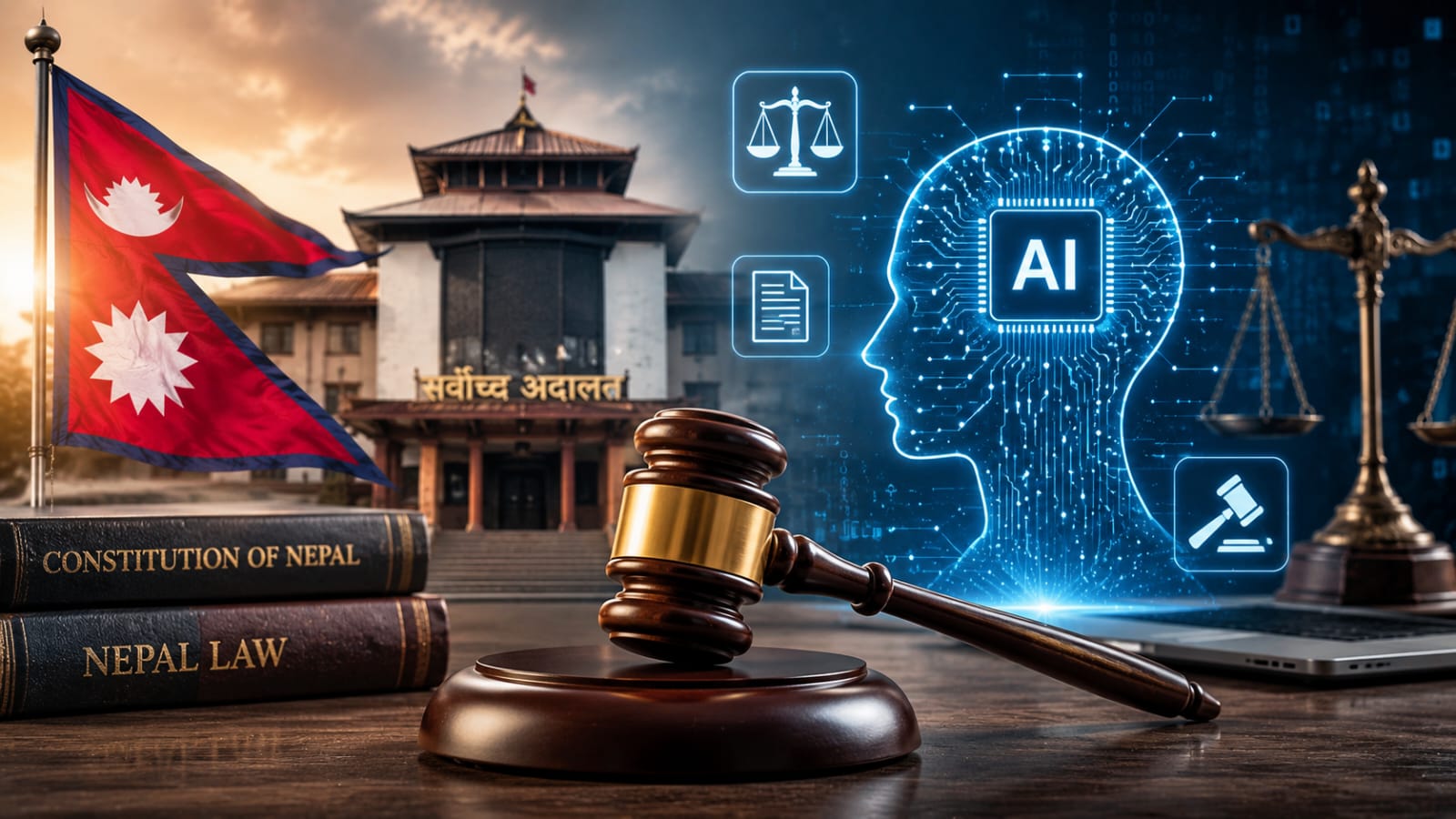
14 May Kathmandu Artificial intelligence is rapidly transforming industries across the world, and Nepal’s legal and judicial system is now beginning to experience that shift. From drafting legal documents to assisting lawyers in legal research, generative artificial intelligence (AI) is slowly entering Nepal’s judiciary and legal profession, raising both optimism and serious concern among legal experts, policymakers, and judicial observers.
A recent opinion article published by The Kathmandu Post warned that while AI has the potential to modernize Nepal’s overburdened legal system, the country remains unprepared for the ethical, legal, and constitutional challenges that may follow widespread AI integration in the judiciary.
The debate has now evolved into a broader national discussion about whether AI should merely support legal professionals — or whether it risks gradually reshaping the country’s justice system itself.
⚖️ AI Slowly Entering Nepal’s Legal Sector
Although Nepal has not formally introduced AI-driven judicial decision-making, artificial intelligence is already beginning to influence legal work in multiple ways.
Legal professionals increasingly use AI-powered tools for:
Drafting petitions
Preparing contracts
Summarizing legal documents
Conducting legal research
Organizing case files
Translating legal content
Managing digital records
According to legal analysts, generative AI systems such as large language models (LLMs) can significantly reduce time spent on repetitive legal tasks.
Some younger lawyers and law students in Nepal have reportedly started experimenting with AI-assisted tools to prepare arguments, analyze judgments, and generate legal summaries. Experts say the attraction is understandable because Nepal’s legal system often suffers from slow administrative processes, heavy paperwork, and growing case backlogs.
Supporters of AI integration believe technology could help improve judicial efficiency and make legal services more accessible, especially in remote parts of Nepal where access to legal expertise remains limited.
However, experts warn that efficiency alone cannot become the only standard for justice.
🤖 The Problem of AI “Hallucinations”
One of the biggest concerns surrounding generative AI is accuracy.
Legal experts warn that AI systems can sometimes generate entirely false information while presenting it in highly convincing language. This phenomenon, widely known as “AI hallucination,” has already created major controversies internationally.
AI-generated legal content may include:
Fake court citations
Invented precedents
Incorrect legal interpretations
Misleading summaries
Non-existent case references
The danger becomes especially serious in legal systems where lawyers or judges rely too heavily on AI-generated material without carefully verifying sources.
According to the Kathmandu Post article, lawyers who use AI irresponsibly risk abandoning their “gatekeeping responsibilities” in protecting legal accuracy and professional ethics.
Legal analysts say Nepal’s judiciary cannot afford widespread misinformation inside courts, particularly in sensitive constitutional or criminal cases.
Experts argue that while AI can assist legal research, human verification must always remain mandatory.
“Technology can assist legal professionals, but it cannot replace professional judgment,” one Kathmandu-based advocate recently stated during a legal discussion on judicial technology.
🔐 Privacy and Confidentiality Concerns
Privacy has emerged as another major concern in Nepal’s growing AI debate.
Lawyers routinely handle highly sensitive information involving:
Criminal investigations
Family disputes
Financial transactions
Government records
Personal identities
Medical information
Experts warn that when lawyers upload confidential client information into AI systems, they may unintentionally expose private data to third-party platforms.
The Kathmandu Post article emphasized that Nepal’s Constitution guarantees privacy as a fundamental right under Article 28.
Similarly, Nepal’s Individual Privacy Act, 2018, restricts unauthorized collection and sharing of personal information.
Legal experts therefore argue that careless AI usage could potentially violate:
Constitutional privacy protections
Professional ethics rules
Client confidentiality obligations
One major concern is that many AI platforms process and store user prompts for system improvement and training purposes.
This creates uncertainty regarding:
Where legal data is stored
Who can access it
How long it remains stored
Whether confidential information may later appear elsewhere
Experts say Nepal currently lacks strong AI-specific legal regulations capable of addressing these issues comprehensively.
🏛️ Can AI Improve Nepal’s Court System?
Despite the concerns, many experts still believe AI could help modernize Nepal’s judiciary if implemented carefully and responsibly.
Nepal’s courts continue facing serious institutional challenges including:
Large case backlogs
Delayed hearings
Administrative inefficiency
Limited digital infrastructure
Shortage of judicial resources
Slow document processing
Observers say AI-assisted administrative systems could help improve several non-judicial functions, including:
Automated scheduling
Digital case management
Translation support
Record organization
Legal database searches
Cause-list preparation
Nepal’s judiciary has already introduced several digital reforms in recent years, including online case registration systems and electronic court management processes.
Some experts believe AI integration represents the next phase of judicial modernization.
Supporters also argue AI could help expand legal accessibility in rural Nepal, where many citizens struggle to access legal advice and court services.
Digital legal assistance tools, they say, could eventually help ordinary citizens better understand laws, legal rights, and court procedures.
⚠️ Experts Warn Against Replacing Human Judgment
While many legal professionals support limited AI assistance, there is strong opposition to allowing AI systems to replace human judicial reasoning.
Judges regularly evaluate:
Human behavior
Witness credibility
Emotional context
Ethical complexity
Constitutional interpretation
Social realities
Legal scholars argue these areas require empathy, moral reasoning, and contextual understanding that AI systems cannot genuinely replicate.
The Kathmandu Post analysis stressed that the real challenge is determining “how far AI integration in the judiciary should go.”
Many experts fear excessive automation could gradually weaken public trust in judicial independence.
Internationally, courts in multiple countries have already emphasized that AI should remain a supporting tool rather than an authority capable of making final legal judgments.
Nepali legal analysts argue the same principle must apply domestically.
🌍 Nepal Reflecting a Global Debate
The debate unfolding in Nepal mirrors broader international discussions regarding artificial intelligence and justice systems.
Around the world, governments and courts are struggling to answer difficult questions such as:
Should AI-generated legal arguments be allowed in court?
Who becomes responsible for AI-generated mistakes?
Can AI remain politically neutral?
How should deepfake evidence be verified?
Can algorithms unintentionally reproduce social bias?
Countries including the United States, members of the European Union, and India have already begun developing legal and regulatory frameworks regarding AI usage in judicial systems.
India’s digital court modernization efforts, particularly under the e-Courts project, are frequently referenced by Nepali analysts discussing judicial technology.
However, experts note that even technologically advanced countries remain cautious about allowing AI to influence core judicial functions.
📱 The Risk of Algorithmic Influence
Another growing concern involves the influence of algorithms on public perception of justice.
Legal observers say court decisions are increasingly consumed through:
Social media summaries
Viral clips
Online commentary
Algorithm-driven platforms
This creates a risk that complex judicial decisions become oversimplified or politically manipulated online.
The Kathmandu Post warned that public trust in courts may increasingly depend not only on judgments themselves, but also on how those judgments are framed and circulated digitally.
Analysts fear misinformation, selective editing, and emotionally charged narratives could distort public understanding of judicial processes.
Some experts say AI-generated misinformation and deepfake technologies could eventually create major evidentiary challenges for courts worldwide — including Nepal.
📜 Nepal’s AI Policy Still Developing
Nepal formally introduced the National Artificial Intelligence Policy, 2025, aimed at guiding AI development across multiple sectors.
However, legal experts argue the policy remains incomplete regarding judicial use of AI.
Critics say Nepal still lacks:
Dedicated AI legislation
Judicial AI guidelines
Data governance standards
Algorithm accountability rules
AI ethics enforcement mechanisms
Analysts believe Nepal’s judiciary, legal associations, and government agencies must now work together to establish clear boundaries before AI usage expands further.
Some legal scholars have proposed:
Specialized judicial AI committees
Mandatory disclosure rules for AI-generated legal content
Privacy protection mechanisms
Professional AI ethics standards for lawyers
Experts say delaying regulation may create future legal confusion.
👨⚖️ Nepal’s Legal Community Divided
Nepal’s legal community itself remains divided regarding AI adoption.
Younger legal professionals and technology advocates often view AI as an opportunity to modernize legal practice and improve efficiency.
Supporters argue AI tools can help:
Reduce repetitive workload
Improve productivity
Speed up legal research
Increase access to information
However, many senior advocates remain cautious.
Critics fear excessive dependence on AI could weaken:
Independent legal reasoning
Professional responsibility
Human judgment
Ethical accountability
Some lawyers also worry AI may eventually widen inequality between technologically equipped law firms and smaller legal practitioners with limited digital resources.
⚖️ Judicial Independence Remains Central
At the heart of the debate lies one core principle: judicial independence.
Experts argue public trust in courts depends heavily on the belief that judges make decisions independently, fairly, and transparently.
If AI systems become too influential in legal interpretation or case analysis, critics fear citizens may begin questioning whether justice is being shaped by human reasoning or machine-generated recommendations.
Analysts say preserving judicial legitimacy must remain Nepal’s highest priority during technological modernization.
“Efficiency should never come at the cost of justice,” one legal commentator recently stated during a public policy discussion in Kathmandu.
📌 Conclusion
Artificial intelligence is beginning to reshape legal systems around the world, and Nepal is now entering that transformation.
Generative AI offers significant opportunities to modernize legal administration, improve efficiency, and expand access to justice. However, experts warn that without proper safeguards, AI integration could also create serious risks involving privacy, ethics, misinformation, accountability, and judicial independence.
Most legal analysts agree on one point: AI should assist Nepal’s judiciary — not replace human judgment.
As Nepal continues modernizing its courts and legal institutions, the country now faces the difficult challenge of balancing technological innovation with constitutional protections, ethical responsibility, and public trust in the justice system.
The debate surrounding AI in Nepal’s judiciary is only beginning, and the decisions made today could shape the country’s legal future for decades.
Tags: Artificial Intelligence Nepal, Nepal Judiciary, AI in Courts, Nepal Law, Generative AI, Legal Technology, Digital Governance, AI Ethics, Nepal Supreme Court, Judicial Reform
🌐 HamroBichar
📧 info@hamrobichar.com