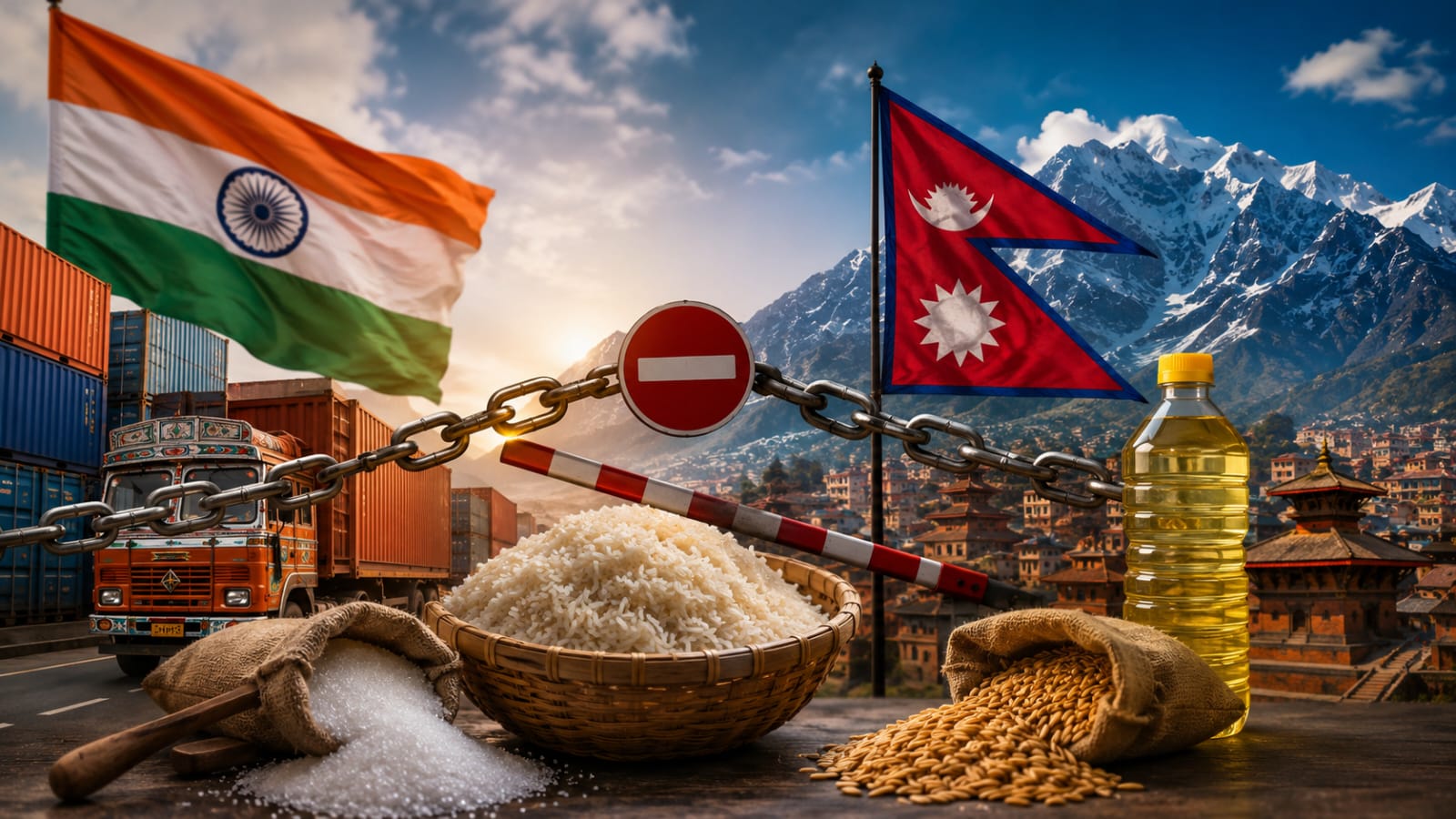
15 May Kathmandu Once again Nepal’s food security, inflation risks and economic vulnerability are under serious concern with India’s repeated export restrictions on essential commodities like sugar, rice and other food products.
The latest worry followed after India imposed a fresh ban on sugar exports until September 2026 to control domestic prices and protect its own market amid fears of reduced agricultural production linked to possible El Niño conditions.
But for Nepal, the decision has sparked a new debate about the country’s heavy reliance on India for critical imports and the growing dangers of protectionist trade policies in the region.
🇮🇳 Nepal is very reliant on India
Nonetheless, India continues to be Nepal’s largest trading partner, accounting for more than 60 percent of Nepal’s total trade volume. The bilateral trade between the two countries crossed over $8 billion in the fiscal year 2023-24.
Nepal imports large quantities of:
- Sugar.
- Rice (white)
- Fuel
- Fertilizer
- Drugs
- Everyday goods
In Nepal, abrupt bans or restrictions on exports from India have a direct impact on market supply and prices.
Officials and economists warn that repeated restrictions reveal Nepal’s fragile dependency on supply chains and weak capacity for domestic production.
🍚 Sugar Ban Brings Old Fears Back
India had put limits on sugar exports in 2023 and only eased the policy partially later on. The latest move again puts pressure on countries such as Nepal which heavily depend on Indian sugar imports.
India’s Directorate General of Foreign Trade has now shifted exports of raw, white and refined sugar from “restricted” to “prohibited” till September 30, 2026.
Indian authorities say the move aims to:
- Avoid domestic supply shortages
-stabilise local sugar prices
- Food security in the context of unpredictable climate conditions
But Nepali officials say the policy could lead to:
-higher consumer prices
- Supply shock
- Higher import costs
Within Nepal.
⚠️ Inflation Worries and Market Pressure
Economists say Nepal is still very vulnerable to external supply shocks because:
- Low industrial capacity
- less agricultural self-sufficiency
- High reliance on imports
If major imports are restricted, immediate effects could be:
- Food prices rising
- Supply shortages
- pressure on foreign exchange reserves
- higher inflation
Concerns over repeated Indian trade restrictions have already been voiced by officials in Nepal’s Ministry of Industry, Commerce and Supplies.
This issue comes at a time when Nepal is already grappling with:
- Gradual economic recovery
- Trade deficit
- Low domestic production
- Increasing living costs
🌾 Food Security Increasingly National Concern
Food security experts warn the country’s reliance on imported staples leaves it more vulnerable to:
- Climatic shocks
- Geopolitical tensions
- International market disruption
- Changes in foreign trade policy
Rice is Nepal’s most important staple food, making up almost 67 percent of the country’s cereal consumption .
At the same time, Nepal has had repeated problems with the supply of fertilizer due to global disruptions and its reliance on imports.
Analysts say the combination of weak agricultural production and import dependence could pose a significant long-term risk if regional supply chains are unstable.
💰 Foreign Currency Reserves tightening
Nepal’s import restrictions often mean it has to look for alternative international suppliers which can:
- increased transportation costs
- Higher import prices
- Pressure the foreign exchange reserves
Experts say Nepal may eventually have to import more food products from:
- South East Asia
- Gulf linked markets
- Other foreign suppliers
if Indian limits continue to expand.
But for landlocked Nepal, other sources are often more expensive and logistically challenging.
🌍 Rise of Regional Protectionism
India’s recent move is in line with a global trend of countries prioritising domestic food security in times of:
- Climate uncertainty
- Inflation of prices
- Economic instability
Global protectionist trade measures have increased since the pandemic and recent geopolitical crises.
Analysts say smaller economies like Nepal are often among the most vulnerable when larger neighboring countries tighten export controls.
🏛️ Nepal Needs to Build More Self-Reliance:
The latest restrictions have seen renewed calls for Nepal to:
- Increase agricultural productivity
- Boost local production of sugar and rice
- Increase import markets
- Enhance food storage systems
- Reliance on one country;
Experts say Nepal should work on long-term economic and agricultural reforms instead of short-term crisis measures.
Some economists also point to the current situation in Nepal as a need for:
- Sovereignty of food
- Modernizing industry
- Tactical stock management
📌 Summary
Nepal’s economic vulnerability and dependence on external supply chains has once again been exposed by India’s reimposition of export restrictions.
As worries mount over inflation, shortages and food security, experts say Nepal needs to urgently improve domestic production and diversify trade options to reduce the risk of regional protectionist policies in the future.
Tags: Nepal India Trade, Food Security Nepal, India Sugar Export Ban, Nepal Economy, Nepal Inflation
🌐 https://hamrobichar.com/
📧 info@hamrobichar.com