14 May Kathmandu Artificial intelligence has become part of everyday life faster than most people expected. What once sounded futuristic is now normal. Students use AI to complete assignments, designers generate artwork in seconds, office workers draft emails with chatbots, and content creators produce videos, scripts, and captions almost instantly.
For many people, AI feels like a revolutionary tool that saves time and improves productivity.
But behind the excitement, a deeper concern is beginning to grow:
What happens when people stop creating and start depending on machines to think for them?
A recent discussion published by The Kathmandu Post explored growing fears that generative AI may slowly weaken human creativity, originality, and independent thinking as people increasingly rely on machines for ideas and answers.
The issue is no longer simply about technology.
It is about human behavior.
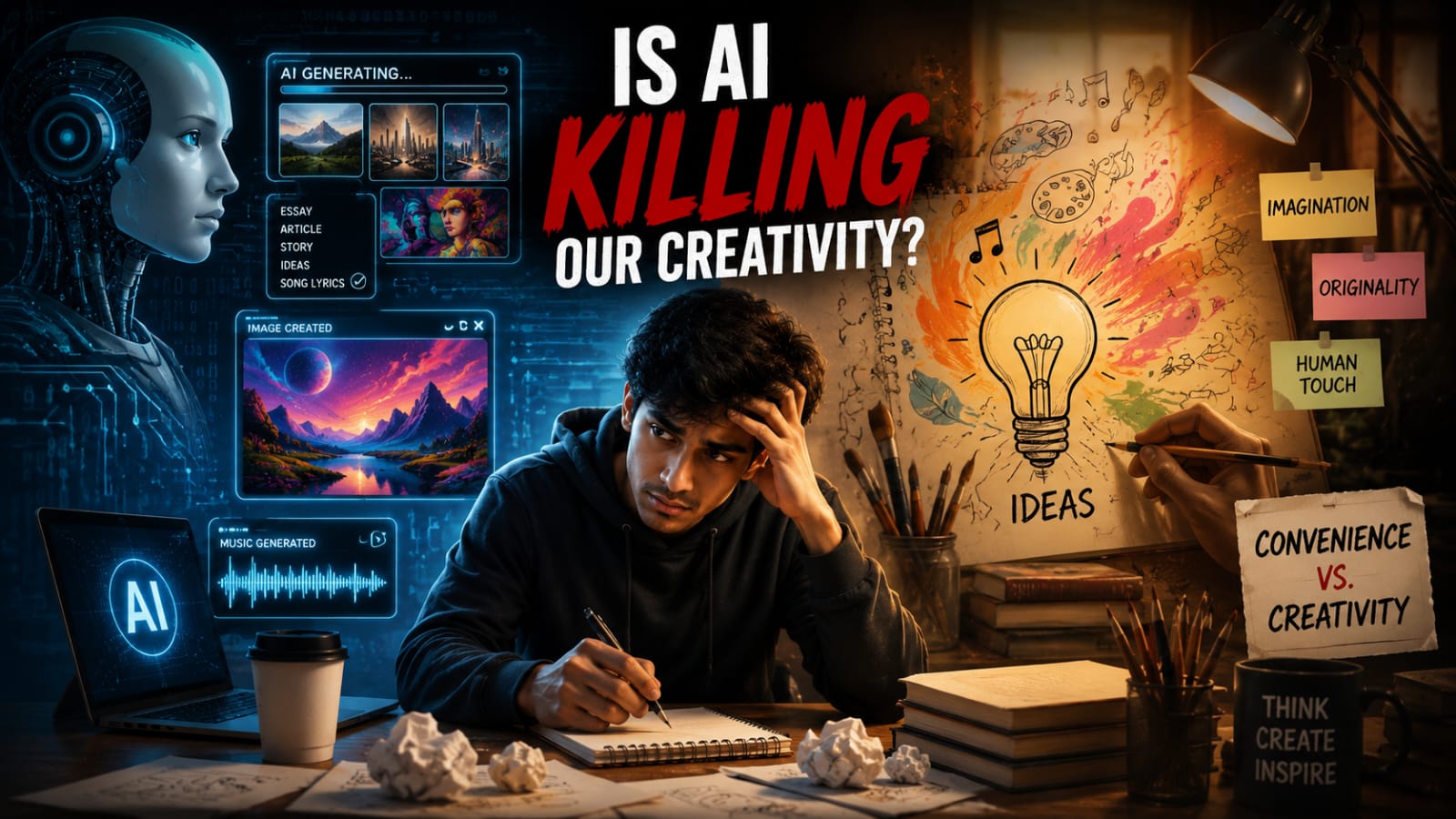
Experts now warn that society may be entering an era where convenience is becoming more valuable than creativity itself.
🤖 AI Has Become Everyone’s Assistant
Artificial intelligence is no longer limited to scientists or big technology companies.
Today, almost anyone with a smartphone can use AI tools for:
Writing essays
Creating images
Editing videos
Solving homework
Generating presentations
Coding applications
Translating languages
Producing music
Summarizing articles
In Nepal, AI adoption has grown rapidly among students, freelancers, digital creators, and office workers.
For many users, AI feels almost magical.
Instead of spending hours brainstorming ideas or searching through information manually, people can now receive instant responses within seconds.
This convenience is exactly why AI has spread so quickly.
But psychologists and educators warn that the brain develops creativity through effort — not shortcuts.
When machines constantly provide ready-made answers, humans may slowly stop exercising the mental skills required for deep thinking.
🧠 Creativity Requires Struggle
Experts say creativity is not just about producing something new.
It is a process.
Human creativity develops through:
Curiosity
Trial and error
Observation
Frustration
Experimentation
Imagination
Independent thinking
Artists, writers, musicians, and inventors often spend years developing ideas through repeated failure and reflection.
AI changes that process dramatically.
Instead of struggling with ideas, users can now instantly generate polished outputs with minimal effort.
Some educators fear this could create a generation increasingly dependent on artificial systems instead of their own imagination.
The Kathmandu Post article highlighted concerns that AI is becoming the “first stop” for ideas and answers, replacing habits of original thinking.
Critics argue this shift may eventually affect:
Critical thinking
Writing ability
Problem-solving skills
Attention span
Creative confidence
In simple terms, if humans stop practicing creativity regularly, creativity itself may weaken over time.
📱 Social Media Is Accelerating the Trend
The rise of AI is happening alongside the explosive growth of short-form digital content.
Platforms like TikTok, Instagram Reels, YouTube Shorts, and Facebook encourage constant production of fast, engaging content.
AI tools now make this process even easier.
A creator can generate:
Video scripts
Voiceovers
Captions
Thumbnails
Music
Images
Blog posts
within minutes.
This has transformed online culture.
Content is being produced faster than ever before.
But experts worry that speed is slowly replacing originality.
Instead of carefully developing ideas, many creators now focus on mass-producing algorithm-friendly content.
The result is an internet increasingly filled with material that feels technically polished but emotionally repetitive.
Media analysts say audiences are also beginning to struggle to distinguish between:
Human-made expression
AI-generated material
Authentic creativity
Algorithmically optimized content
Some fear digital culture is becoming less personal and more automated.
🎨 Artists Fear Creativity Becoming “Artificial”
The debate has become especially intense within creative industries.
Artists around the world — including in Nepal — are increasingly questioning how AI-generated content will affect human creativity and creative jobs.
Graphic designers, musicians, photographers, filmmakers, and writers worry AI systems can imitate styles and generate content at enormous speed.
This creates several concerns:
Will companies replace human creators with AI?
Can AI-generated art truly be considered “art”?
What happens to originality if machines learn by copying existing human work?
Will creativity become commercially automated?
Many artists argue that human creativity comes from lived experience.
A machine can imitate emotion, they say, but it cannot genuinely experience:
Love
Grief
Fear
Poverty
Memory
Loneliness
Human relationships
Because of this, critics believe AI-generated content may eventually feel technically impressive but emotionally hollow.
At the same time, some creators strongly support AI tools.
They argue AI can help artists experiment faster, reduce repetitive work, and explore new creative possibilities.
The debate remains deeply divided.
🏫 Schools and Universities Facing a New Crisis
Education systems are now among the sectors most heavily affected by AI.
Teachers worldwide — including in Nepal — report increasing use of AI-generated assignments among students.
Students can now ask AI systems to:
Write essays
Solve math problems
Summarize books
Generate presentations
Create reports
within seconds.
This has created a major challenge for schools and universities.
Educators are struggling to answer difficult questions:
Is AI-generated homework genuine learning?
Should AI assistance be considered plagiarism?
How can originality be measured?
Are students still developing thinking skills?
Some teachers worry students may gradually lose patience for reading, researching, and independent analysis because AI provides instant shortcuts.
The concern is not simply cheating.
It is cognitive dependency.
If students constantly rely on AI for thinking, experts fear they may become less capable of solving problems independently later in life.
However, others argue AI cannot realistically be banned.
Instead, many experts believe education systems must now evolve.
Rather than focusing only on memorization, schools may increasingly emphasize:
Critical analysis
Discussion
Real-world problem solving
Oral communication
Creative reasoning
Experts say future education may depend less on “finding information” and more on understanding how to think critically about information.
⚠️ Convenience Can Change Human Behavior
Psychologists warn that convenience itself can reshape human habits.
Human beings naturally prefer easier solutions.
AI systems exploit that tendency perfectly by offering:
Instant answers
Instant ideas
Instant creativity
Instant productivity
But experts fear over-reliance on instant solutions may weaken the mental endurance required for deeper thinking.
The danger, according to critics, is not that AI becomes intelligent.
It is that humans may become mentally passive.
Some psychologists compare AI dependency to earlier technological shifts caused by:
Smartphones
Social media
GPS navigation
Calculators
Each technology improved convenience while simultaneously reducing certain human skills.
For example:
GPS reduced navigational memory
Smartphones reduced memorization habits
Social media reduced attention spans
Now experts fear AI could reduce creative thinking itself.
🌍 The Debate Is Global — Not Just Nepali
The conversation surrounding AI and creativity is happening worldwide.
Governments, universities, technology companies, and artists across multiple countries are debating the long-term impact of generative AI.
Some researchers warn AI may eventually flood the internet with synthetic content so rapidly that authentic human expression becomes harder to recognize.
Others argue humanity has always adapted to new technologies.
Supporters of AI point out that every major invention initially created fear.
When photography emerged, some painters feared art would die.
When digital editing software appeared, traditional filmmakers worried creativity would disappear.
When the internet transformed journalism, many feared writing quality would collapse completely.
Yet human creativity survived each technological revolution.
Supporters believe AI will simply become another creative tool — not a replacement for imagination itself.
The real question, they argue, is whether humans continue thinking independently while using those tools.
🇳🇵 Nepal’s Digital Generation Faces a Turning Point
Nepal’s younger generation is now growing up in a world where AI is becoming normal very quickly.
Students, creators, freelancers, and entrepreneurs increasingly use AI tools daily.
For a developing country like Nepal, AI also creates exciting opportunities.
Technology can help improve:
Education access
Productivity
Language translation
Digital entrepreneurship
Small business efficiency
Creative experimentation
Many Nepali creators already use AI for design assistance, editing support, and brainstorming ideas.
However, experts say Nepal still lacks broader national discussion regarding:
AI ethics
Educational policy
Digital dependency
Copyright regulation
Creative protection
Analysts warn Nepal must prepare carefully because AI’s influence will likely grow much faster in coming years.
📜 The Real Danger May Not Be AI Itself
Interestingly, many experts believe AI itself is not the true problem.
Instead, they argue the bigger danger lies in how humans choose to use it.
AI can either:
Support creativity
Or replace creative effort entirely
The outcome depends on human behavior.
Some experts compare AI to calculators.
Calculators made mathematics easier, but people still needed to understand mathematical reasoning.
Similarly, AI may assist creativity, but humans must still actively think, question, imagine, and create.
The danger begins when people stop participating mentally and allow machines to do all intellectual work for them.
As one broader cultural concern highlighted in current discussions suggests, society risks becoming more efficient while simultaneously becoming less reflective.
📌 Conclusion
Artificial intelligence is transforming modern life at extraordinary speed, and Nepal is becoming part of that global transformation.
AI offers powerful advantages:
Faster productivity
Easier access to information
Creative assistance
Educational support
Business efficiency
But experts increasingly warn that excessive dependence on AI may gradually weaken the habits that make humans creative in the first place.
Creativity is not only about producing results.
It is about thinking, struggling, experimenting, imagining, and discovering meaning through effort.
Machines can generate outputs.
But human creativity has always come from lived experience, emotion, curiosity, and independent thought.
The future may therefore depend not on whether AI becomes more intelligent — but on whether humans continue using their own minds alongside it.
If society chooses convenience over creativity completely, experts fear people may eventually lose something far more important than efficiency:
the habit of thinking for themselves.
Tags: Artificial Intelligence, AI Creativity, Nepal Technology, Human Creativity, AI Ethics, Digital Culture, Nepal Society, AI Education, Technology and Society, Generative AI
🌐 HamroBichar
📧 info@hamrobichar.com