Russian Foreign Minister Sergey Lavrov rejected Germany’s call for Moscow to abandon what Berlin described as a dangerous path of escalation during a rare meeting at the UN General Assembly.
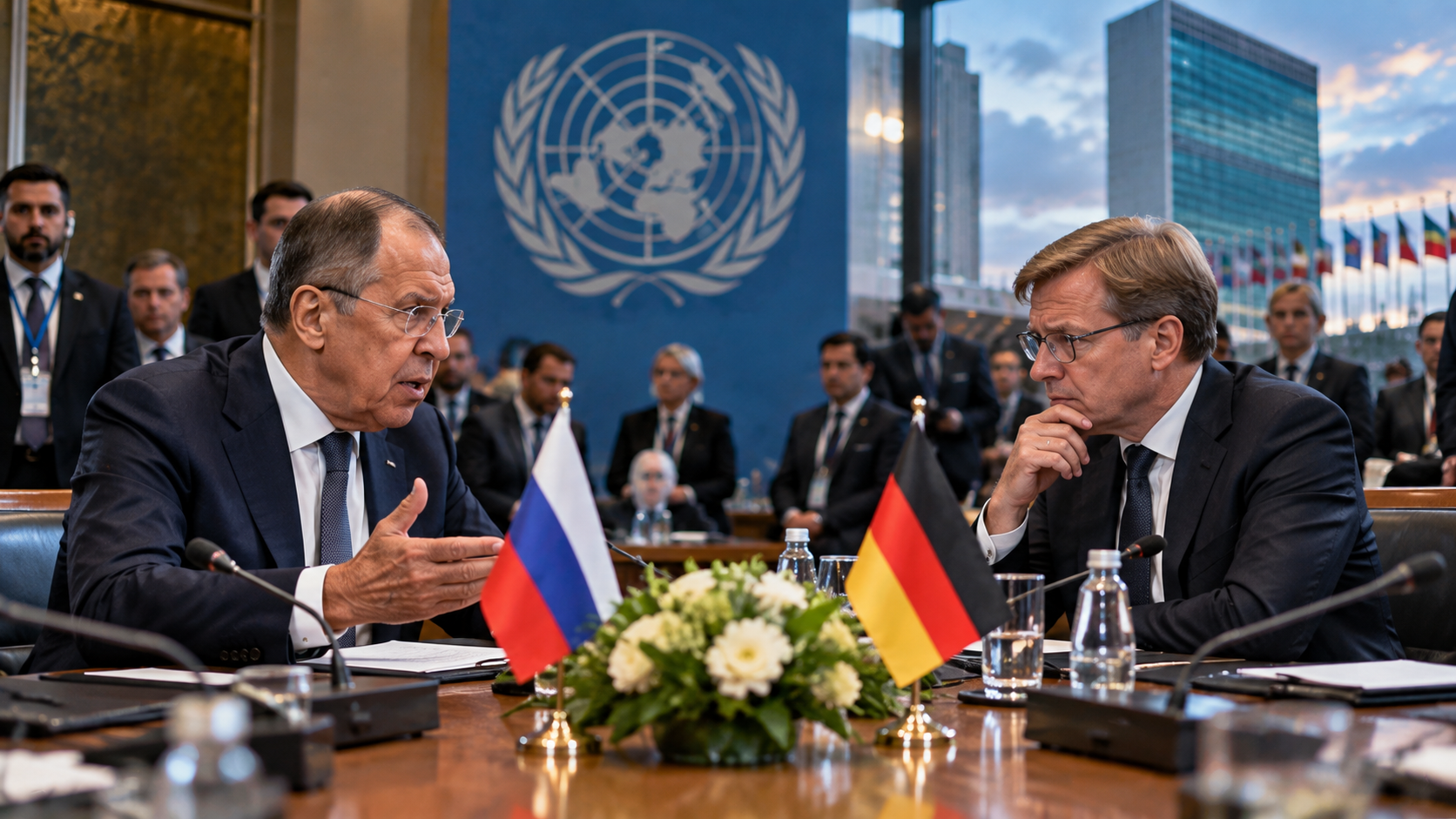
The exchange followed a rare meeting between Lavrov and German Foreign Minister Johann Wadephul on the sidelines of the 81st UN General Assembly on September 26.
According to a German delegation official, Wadephul urged Russia to abandon what Germany considers an escalating course toward Germany, Europe and NATO.
Wadephul also indicated that Berlin remained open to improving relations with Moscow, but said this would require a genuine willingness from Russia’s leadership to end the war in Ukraine.
Germany has increasingly framed Russia’s actions as a wider security concern for Europe.
Before travelling to New York, Wadephul said Germany wanted an immediate ceasefire, the resumption of negotiations and a peaceful resolution of the war based on international law.
Lavrov dismissed the German foreign minister’s appeal during his remarks at the UN and later told reporters that the meeting had produced no new developments.
He accused Germany of being a major supporter of Ukraine and argued that Berlin was seeking a stronger military role in Europe.
Lavrov also invoked the history of the Second World War while questioning Germany’s current security policies.
The Russian foreign minister said the German position represented escalation rather than an opening for improved relations.
The meeting between the two foreign ministers was notable because direct high-level contact between Moscow and Berlin has become rare since Russia launched its full-scale invasion of Ukraine in 2022.
Relations have deteriorated further in recent weeks following Germany’s accusations that Russia was behind an attempted drone attack at Leipzig/Halle Airport.
Berlin has also announced measures against Russian diplomatic and cultural facilities, while Moscow has rejected Germany’s accusations.
German officials have described the broader pattern as part of a series of Russian actions that they say threaten European security.
Russia has rejected those allegations and has accused European governments of adopting increasingly confrontational policies toward Moscow.
Lavrov also used his UN appearance to address Germany’s and Japan’s ambitions for permanent seats on the Security Council.
He said Russia would oppose efforts to give either country a permanent position on the council.
The issue reflects a wider debate over reforming the UN Security Council, whose five permanent members—China, France, Russia, the United Kingdom and the United States—hold veto power.
Germany and Japan have long sought a greater role in the council alongside other countries advocating expansion of its permanent and non-permanent membership.
The disagreement between Moscow and Berlin remains closely connected to the war in Ukraine.
Germany has continued supporting Ukraine and has called for negotiations aimed at ending the conflict. Russia, meanwhile, maintains that its objectives in Ukraine will be achieved and has accused European governments of obstructing diplomatic efforts.
The two sides therefore remain far apart on both the war itself and the broader security relationship between Russia and Europe.
Their exchange at the UN offered a rare opportunity for direct communication, but the public statements that followed showed that major disagreements remain unresolved.
Comments
0 comments
Loading comments...