Nepal’s rapid shift to electric mobility has reduced fuel dependence, but safety standards, vehicle testing and emergency preparedness have not kept pace with the EV boom.
Nepal’s transition toward electric mobility has been one of the more visible successes of its energy and transport policy. Electric vehicles have become increasingly common on Nepali roads, helping reduce dependence on imported petroleum and offering an alternative in a country with abundant hydropower potential.
But the speed of that transition has exposed another problem: regulation has not developed at the same pace.
A recent electric vehicle fire in Bharatpur, in which a 55-year-old man died, has intensified public concern about EV safety. Investigators have not yet established what caused the fire. Possible explanations include a charging-system fault, mechanical failure, previous collision damage or a battery-related incident. Treating one accident as proof that electric vehicles are inherently dangerous would therefore be premature.
The incident does, however, raise a legitimate policy question: Does Nepal have a sufficiently strong system for testing and regulating the electric vehicles entering its market?
An EV fire can have multiple causes, and battery failure is only one possibility. Thermal runaway—a chain reaction in which excessive heat causes further battery-cell failure—is a recognised risk associated with damaged, defective or improperly managed lithium-ion batteries.
That does not make EVs uniquely unsafe. The broader question is whether vehicles, batteries and charging equipment meet appropriate safety requirements before they reach consumers.
Nepal’s challenge appears to lie precisely here.
The Kathmandu Post editorial notes that Nepal does not currently have a dedicated mechanism comparable to established international systems for determining whether imported EVs meet recognised safety benchmarks.
That is a regulatory gap worth addressing regardless of how the Bharatpur investigation ultimately concludes.
Nepal does not need to create an entire EV-safety system from scratch.
UN Regulation No. 100 provides a framework for the approval of electric and hybrid vehicles, including requirements concerning electrical safety and the construction and functional safety of electric powertrains. UNECE describes type approval as a process through which authorities verify whether vehicles comply with prescribed technical requirements.
This gives Nepal a practical policy option: require imported EVs to demonstrate compliance with a recognised international safety standard before receiving approval for the domestic market.
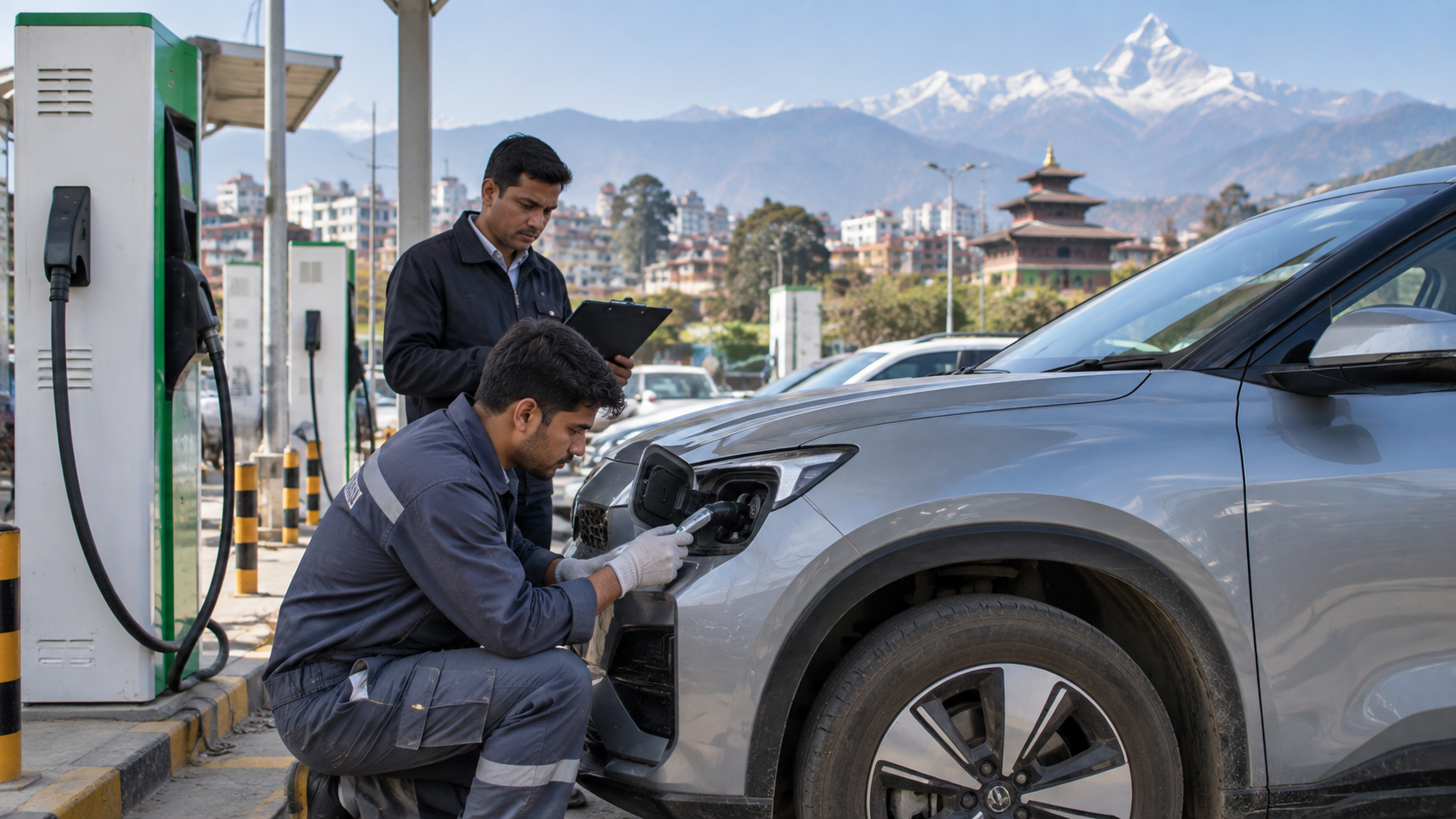
Such a system could cover more than the vehicle itself. Battery packs, charging equipment, cables and critical electrical components also deserve appropriate technical scrutiny.
Major EV-producing countries are also tightening their requirements.
China’s revised mandatory battery-safety standard, which took effect in July 2026, introduced additional requirements covering thermal diffusion, battery impact protection and safety after repeated fast-charging cycles. Some tests require batteries to avoid fire or explosion under specified conditions.
The lesson for Nepal is not that it should copy another country’s regulations word for word.
Rather, it should recognise that EV safety is a rapidly developing technical field and that regulatory standards must evolve alongside the technology.
Regulation should not stop at the customs border.
Emergency responders need to understand how EV accidents differ from conventional vehicle incidents. Battery fires can require different tactics, and damaged high-voltage systems can create additional hazards for rescuers.
Vehicle owners also need basic safety information.
They should know how to disconnect a vehicle when appropriate, where mechanical door releases are located and what precautions to take after serious collisions or suspected battery damage.
These are practical safety measures, not arguments against electric mobility.
As EV ownership expands, charging infrastructure will become an equally important part of the safety equation.
A vehicle can meet appropriate standards while unsafe installation, poor-quality equipment or inadequate electrical protection creates another point of failure.
Nepal therefore needs clearer requirements covering charging-station installation, electrical protection, equipment certification, maintenance and inspection.
The country’s transition to EVs should not produce a situation in which vehicle regulation advances while charging infrastructure remains loosely supervised.
There is a strong reason to regulate EVs better: Nepal should not undermine a transition that has delivered genuine economic and environmental benefits.
Electric mobility can help reduce petroleum imports and urban air pollution. Stronger safety regulation would strengthen public confidence rather than weaken the EV sector.
The objective should therefore not be to slow EV adoption.
It should be to make the market more trustworthy.
A sensible framework could include mandatory type approval for imported EVs, recognised battery-safety certification, stronger standards for chargers and cables, regular technical inspection, transparent reporting of serious EV incidents and specialised training for firefighters and emergency personnel.
Nepal could also require manufacturers and importers to provide clear emergency-response information for each vehicle model.
Nepal has already demonstrated that it can move quickly when the economic case for electric mobility is clear.
The next stage requires the same determination in regulation.
One vehicle fire should not become an excuse for abandoning electric mobility. At the same time, public enthusiasm for EVs should not prevent authorities from asking difficult questions about safety, certification and accountability.
Nepal’s EV transition will be sustainable only when cleaner transport is matched by safer transport.
The country has embraced the electric vehicle. Now its regulators need to catch up.
Comments
0 comments
Loading comments...