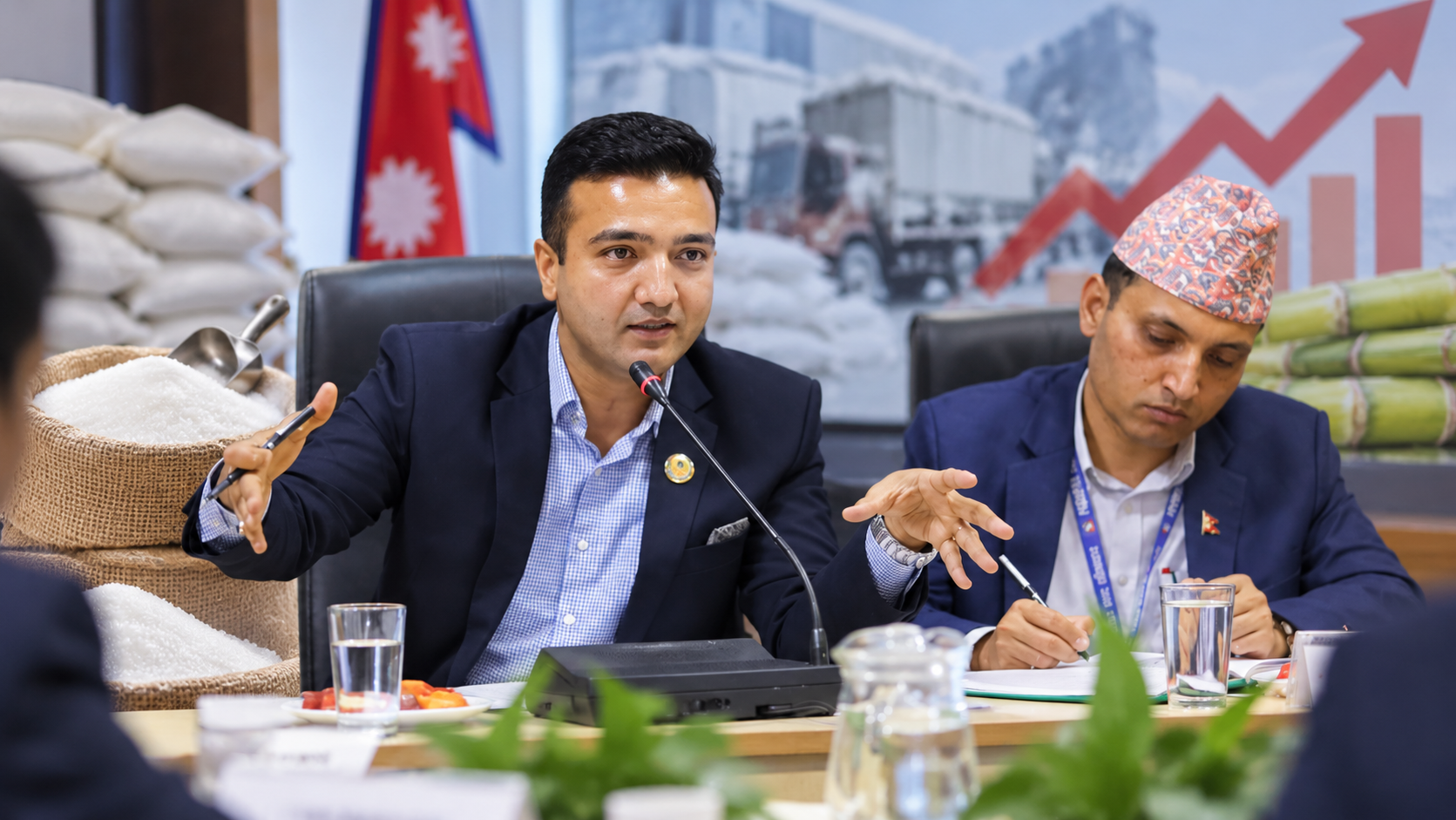
Parliamentary committee chairperson Rahbar Ansari has questioned the sharp rise in sugar prices in Nepal and urged the government to strengthen market monitoring, control shortages and take timely measures to protect consumers.
Speaking at a meeting of the Industry, Commerce, Labour and Consumer Welfare Committee, Ansari said the government had earlier assured consumers that Nepal had sufficient sugar stocks and that prices would not rise significantly following India's decision to restrict sugar exports. However, prices have increased substantially within just a few months.
According to Ansari, sugar that previously cost around Rs 85 per kilogram before VAT, or roughly Rs 96 after VAT, is now being sold in the market for between Rs 105 and Rs 130 per kilogram.
He questioned why prices had risen so sharply despite earlier claims that Nepal had sufficient stocks.
Ansari said the government needs to investigate the reasons behind the increase and determine whether supply problems, delayed imports or market practices are contributing to the higher prices.
The issue has become particularly important ahead of the major festival season, when household demand for essential food items typically increases.
Ansari argued that Nepal's failure to arrange alternative sugar imports in time contributed to the current situation.
After India restricted sugar exports, Nepal needed to look for alternative international suppliers to maintain adequate stocks. Ansari said that delayed action on imports eventually contributed to shortages and upward pressure on prices.
Recent reports have also shown that sugar prices in Nepal remain considerably higher than in parts of neighbouring India. In the border market of Jogbani, sugar was reported at around Rs 90 per kilogram, while retail prices in Biratnagar were around Rs 120.
The government has since authorised the import of sugar through state-owned trading entities in an attempt to improve supply.
The government has said that measures are being taken to ease the shortage.
Industry, Commerce and Supplies Minister Gauri Kumari Yadav recently told the parliamentary committee that 22,500 metric tonnes of sugar had been approved for import through Salt Trading Corporation and another 2,500 metric tonnes through Food Management and Trading Company.
The government-owned companies have also been selling sugar at prices substantially below those reported in some private markets, according to the minister.
The minister said sugar sold through Food Management and Trading Company was priced at around Rs 109 per kilogram, while Salt Trading Corporation was selling it at about Rs 105.
She warned that prices significantly above the government-backed rates could lead to action.
Ansari also urged the government to move faster on legislation aimed at protecting consumers and controlling unfair market practices.
He called for necessary bills and laws addressing consumer protection, cartelisation and black marketing to be presented to Parliament as soon as possible.
He argued that protecting consumers should remain a central responsibility of the government while also maintaining a healthy environment for businesses and industries.
The committee chair also raised concerns about how market monitoring is being conducted.
According to Ansari, market inspections should be practical, evidence-based and reasonable, rather than simply focused on conducting inspections for their own sake.
He also called for greater transparency over expenses related to market monitoring, particularly the purchase of expensive software and other technological systems.
His comments come as the government has intensified market inspections following disruptions to supply chains and concerns about price manipulation, artificial shortages and the quality of essential goods.
The sugar issue is part of a broader challenge facing Nepal's consumer market.
Disruptions to transportation and supply chains following recent floods have increased concerns about the availability and prices of essential commodities. Consumer rights activists have argued that the government needs accurate information about stocks, supply routes and expected demand to conduct effective market regulation.
Earlier reports also showed that prices of several essential commodities, including rice, cooking oil and sugar, had increased significantly in recent months.
For consumers, the key concern now is whether the government's import and monitoring measures will translate into lower retail prices.
As the festival season approaches, maintaining adequate sugar supplies and preventing artificial price increases will remain an important test of the government's market-management system.
HamroBichar will continue to follow developments in sugar prices, essential commodity supplies and the government's market-monitoring measures.
Tags: Sugar Price Nepal, Nepal Economy, Market Monitoring, Consumer Rights, Rahbar Ansari, Sugar Import, Black Marketing, Nepal Business
Comments
0 comments
Loading comments...