Nepali Congress lawmaker Sita Thapaliya questioned RSP leaders over political statements surrounding the Saptari hospital incident and demanded accountability for the affected family.
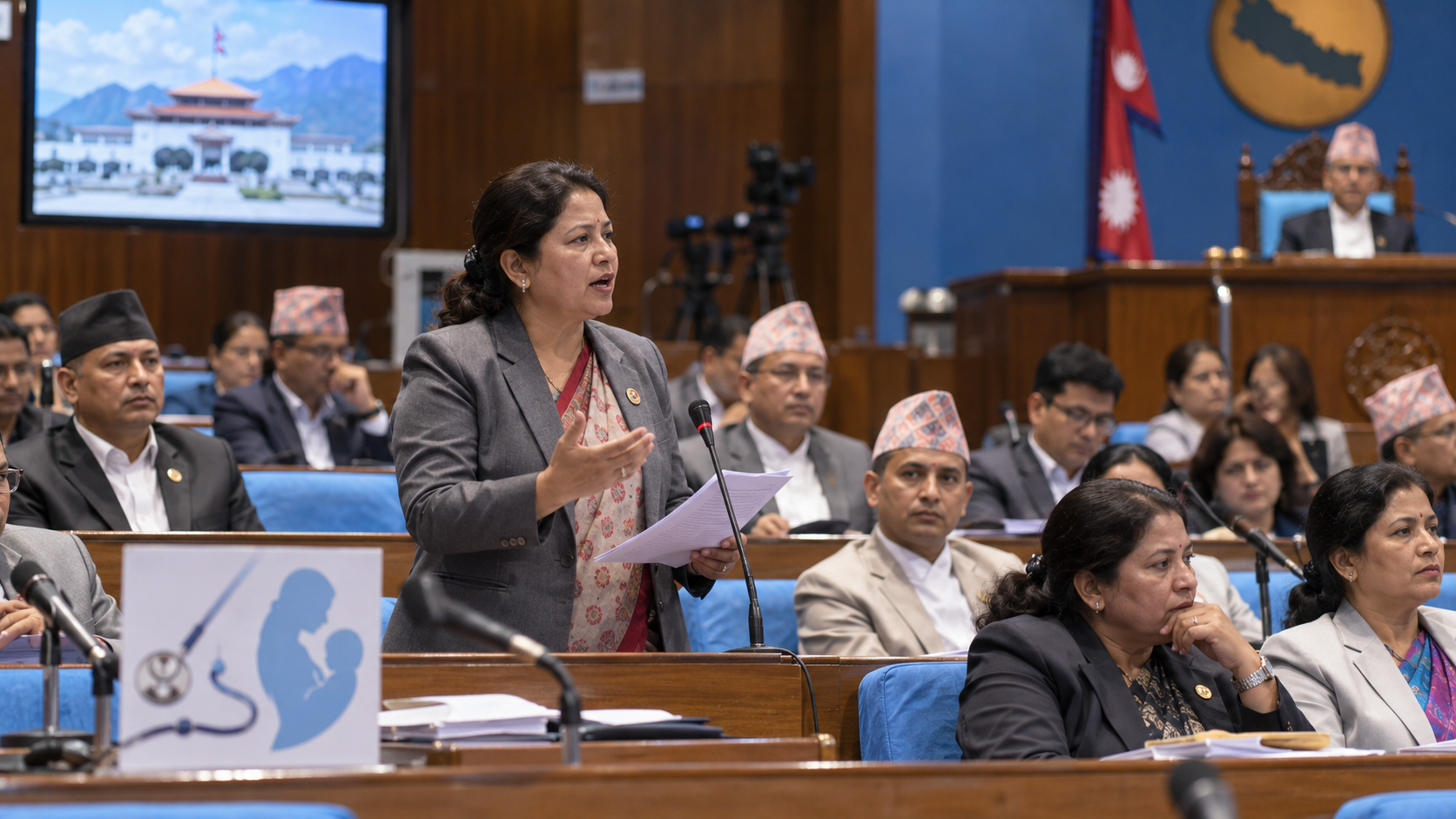
Speaking during Thursday's meeting of the House of Representatives, Thapaliya criticised what she described as attempts by some leaders of the ruling Rastriya Swatantra Party (RSP) to portray the incident as a possible political conspiracy against the government.
She argued that disagreements between the government and opposition are part of parliamentary politics, but said the suffering of a woman in labour should not become an instrument for political confrontation.
The controversy follows the case of Babita Kumari Paswan of Saptari, who gave birth on a pavement outside Gajendra Narayan Singh Hospital in Rajbiraj earlier this month.
Reports said Paswan and her husband reached the hospital while she was in labour but faced difficulties obtaining required tests because they could not immediately arrange the money requested for them. She subsequently delivered her baby outside the hospital.
The incident prompted public criticism and investigations into the hospital's handling of the case.
The government and health authorities have since taken steps to investigate the circumstances surrounding the incident. The hospital also suspended six people pending the investigation, according to reporting by The Kathmandu Post.
In Parliament, Thapaliya called on the government to clarify whether action would be taken against those responsible and whether the affected family would receive justice.
She also asked what measures were being introduced to prevent similar incidents from happening again.
Her remarks also touched on the government's broader commitments following its formation. She asked the government to provide an account of progress on its 100-point commitment and distinguish between measures that have been implemented and those that remain outstanding.
The parliamentary debate comes after lawmakers from the ruling RSP themselves raised concerns about the Saptari case.
RSP lawmaker Toshima Karki called for expansion of the government's Aama Suraksha Programme so that women receive free healthcare throughout pregnancy and childbirth. She also called for a “No Denial in Labor” policy requiring hospitals to admit women arriving in labour and demanded an investigation into the treatment of Paswan.
Other lawmakers have similarly demanded accountability over the incident.
This means the parliamentary debate has involved criticism of the hospital's handling of the case from lawmakers across political lines, even as disagreements have emerged over how the incident should be discussed politically.
The Saptari case has also exposed questions about the gap between Nepal's policy of free maternity services and the costs that patients can encounter before receiving treatment.
The Kathmandu Post reported that delivery services are free under the government's Safe Motherhood Programme, but laboratory tests required before delivery have not been uniformly included in the same reimbursement arrangement. That has contributed to uncertainty among hospitals and health workers over who should bear those costs.
The incident has consequently generated a wider discussion about whether emergency maternity care can be effectively guaranteed if patients face financial barriers to diagnostic services.
Thapaliya's comments reflect a broader parliamentary question about how political parties should respond to failures in public services.
Opposition parties have a role in scrutinising government performance, while the government is responsible for explaining what went wrong and what corrective measures are being taken. At the same time, the circumstances of an individual patient's medical emergency require investigation based on evidence rather than assumptions about political motives.
In the Saptari case, the investigation into the hospital's conduct remains important for establishing responsibility and identifying institutional shortcomings.
The immediate political dispute is likely to continue, but the incident has also produced a set of concrete questions for Nepal's health system: whether women in labour can obtain emergency admission without delay, how essential tests should be financed, how hospitals should handle patients unable to pay and what accountability mechanisms should apply when procedures fail.
For lawmakers, the case provides an opportunity to examine those questions beyond partisan disagreement.
For the affected family, the central issues remain more direct—access to care, accountability and assurance that similar circumstances will not be repeated.
Comments
0 comments
Loading comments...