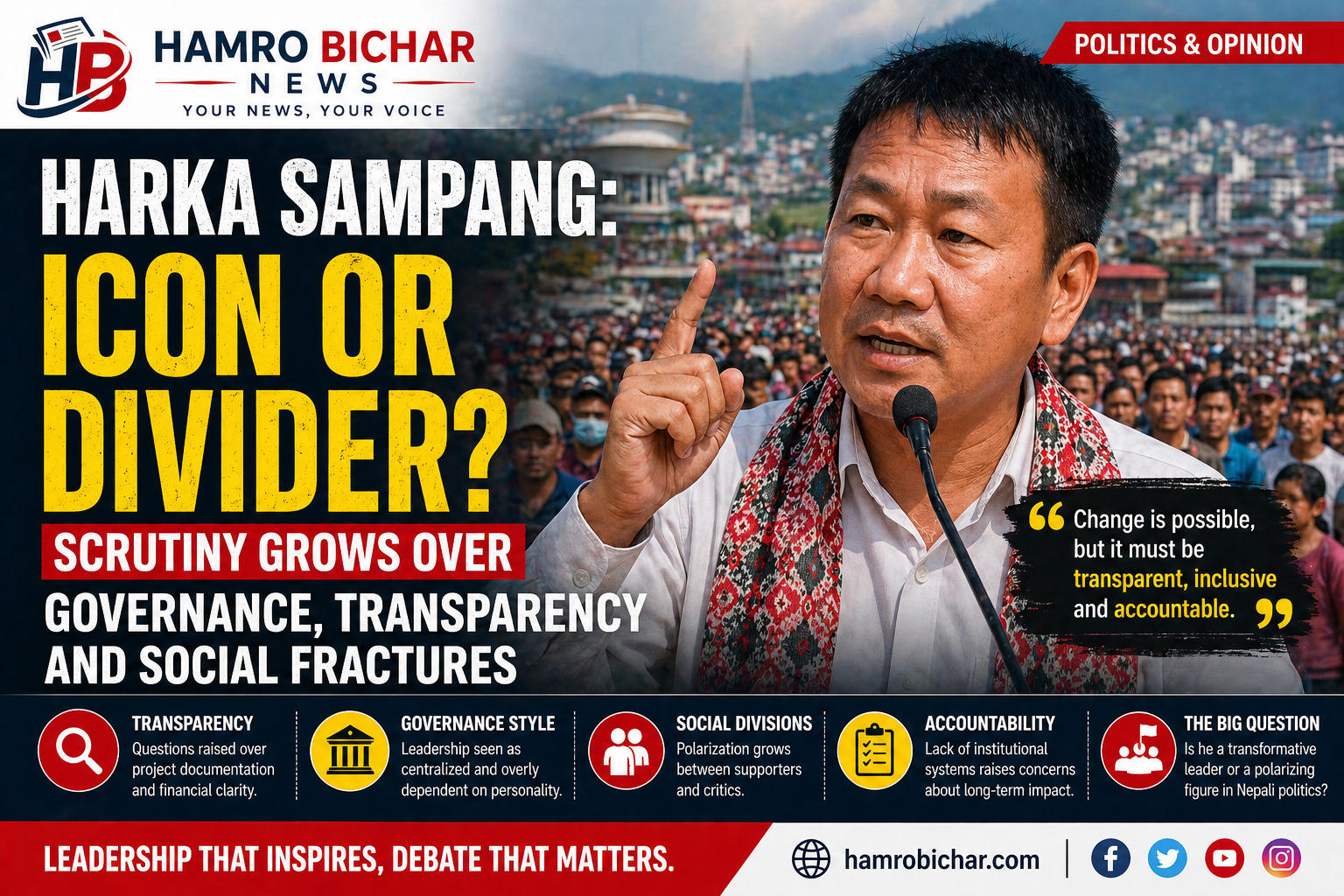
30 April Kathmandu The rise of Harka Sampang in Nepal’s political arena has been nothing short of remarkable. Emerging from Dharan as an independent leader, he swiftly captured national attention for his challenge to traditional political systems and his call for bottom-up governance.
But with his increasing influence comes increasing scrutiny. Now questions are being raised about transparency, governance practices and the broader social impact of his leadership style.
🌟 The Change Symbol
Harka Sampang received a lot of recognition after winning the local elections as an independent candidate. He was a different kind of political leader than the ones who came before.
He became popular for:
• Community engagement to lead development activities
• Promotion of Shramdaan (Volunteering)
• Promoting self-sufficiency rather than reliance on government systems
To many citizens, particularly the young, he was a symbol of hope and change in a system often accused of corruption and inefficiency.
⚖️ Transparency concerns
He is building support but questions are being raised about how decisions are made in his name.
Some critics contend that:
• There is little formal documentation for projects.
• There’s not always transparency in finance
• Decisions tend to be centralized instead of institutionalized
While supporters are concerned with results, critics stress the need for accountability and structured governance.
🏛️ Governance and Self-Leadership
The debate has a key question: can his leadership be sustained in the long term?
Critics say:
• His personal involvement is crucial for the functioning of governance
• Systems and policies are badly institutionalized
• Long term planning not clear
Supporters say:
• His practical involvement accelerates development
• He cuts through bureaucratic delays
• He addresses the public directly
That opens a bigger debate about whether leadership should be system-driven or personality-driven.
🧩 Social Impact and Division
There is also increasing concern about the social impact of his leadership.
It has been found that:
• He has strong opinions and sometimes polarizes views
• Debate in public about his policies can be divisive
• The gap between supporters and critics is widening
Some feel his approach may instead deepen divisions rather than unite communities.
🌍 The Concept of His Leadership
His style of rule can be summed up as:
• Community involvement
• Self-reliance
• Immediate action, no waiting for bureaucracy
While this model has demonstrated tangible benefits in some areas, experts remain skeptical that it can resolve more complex administrative issues that call for organized planning and coordination.
👥 Public Opinion: Divided Response
Public opinion on Harka Sampang is still divided.
Supporters argue:
• He is honest and free of corruption
• He creates real change
• He makes it possible for average citizens
Critics say:
• He is not transparent in his governance
• His method is not sustainable
• His leadership style is divisive
This difference in perception makes him one of the most debated figures in the present Nepali politics.
📊 A Bigger Political Meaning
This discussion reflects a broader change happening in Nepal:
• More and more disgruntled with mainstream political parties
• Emergence of autonomous leaders
• Demand for visible, faster development
At the same time it stresses the importance of:
• Solid institutions
• Responsibility
• A balanced leadership.
🔮 Now What?
And with his influence expanding, so does the anticipation.
Key questions for the future include:
• Can his leadership evolve into a structured governance model?
• Will transparency get better over time?
• Can he unite rather than divide opinion?
His future success will depend on balancing
👉 Good leaders + Good systems
🧾 Last Words
Harka Sampang is a symbol of hope and controversy in Nepal’s changing political landscape.
He inspired many by challenging traditional systems and promoting grassroots development. At the same time, concerns about transparency, sustainability and social cohesion are growing.
Only time will tell how his leadership shapes up in the years to come, and whether he will be seen as a transformative leader, or a divisive figure.
Comments
0 comments
Loading comments...