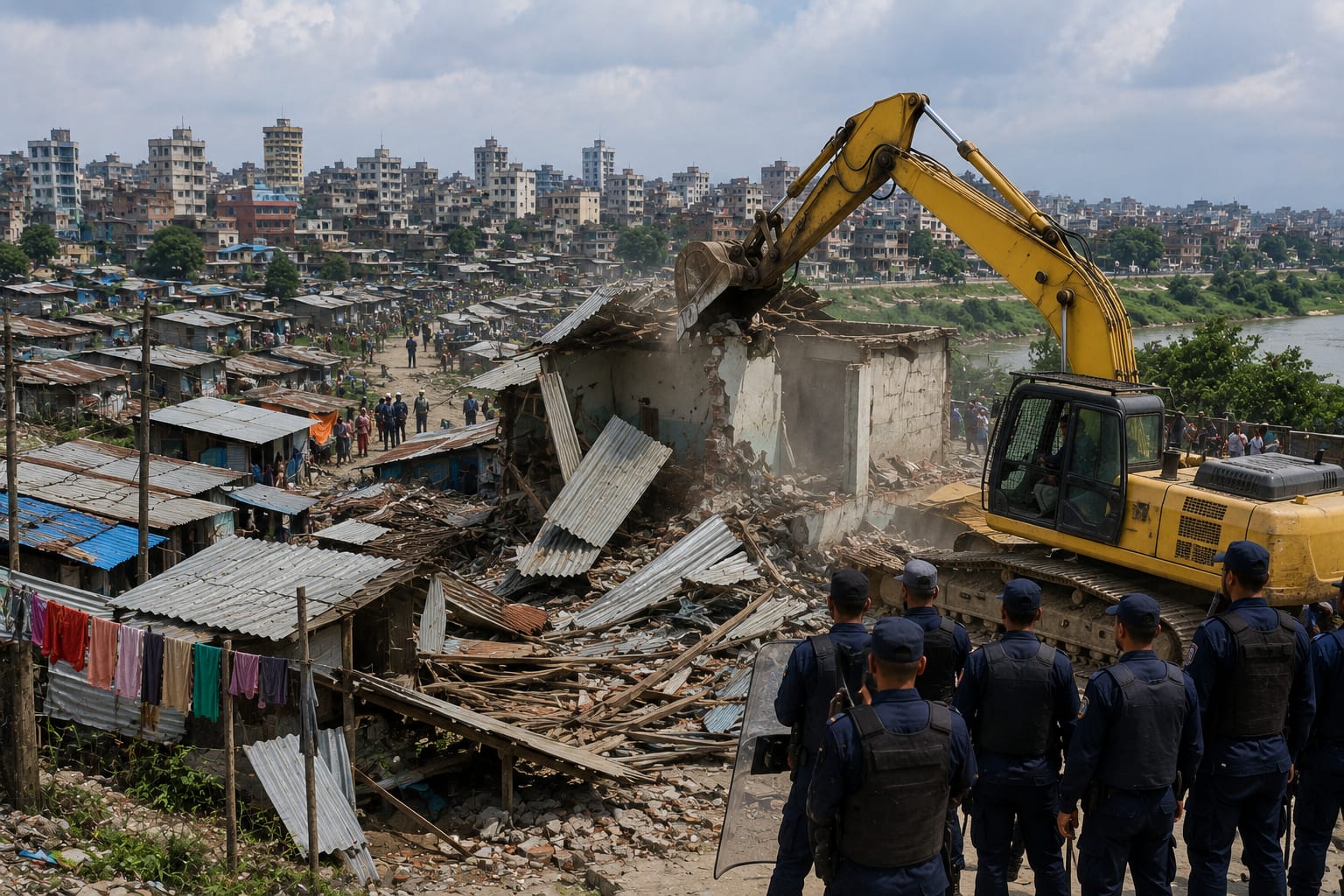
7 May Kathmandu The ongoing anti-encroachment drive in Nepal has brought renewed attention to decades-long expansion of settlements on public, forest and riverbank land in several districts of the country.
Thousands of families living in informal settlements now face uncertainty about housing and land rights and relocation as authorities step up demolitions and evictions. The issue has led to a national debate on how to balance land management, environmental protection and humanitarian concerns.
🏘️ Over decades of settlements
Reports say that large tracts of public land in Rupandehi, Palpa, Makwanpur and Dang districts have slowly turned into thickly populated residential and market areas in a couple of decades.
Some of these settlements
- Started as small landless communities
- Expanded with political protection and light regulation
- Over the years, built roads, schools and commercial infrastructure
In some areas, local authorities even approved building plans and levied taxes without residents having official certificates of land ownership.
🌳 Encroachment in Forest and Chure Region
Authorities and researchers warn settlement expansion has increasingly encroached on:
- Forest and woodland land
- Riversides
- Chure foothills
- Public lands protection
In Rupandehi’s Devdaha and Sainamaina municipalities, a good part of settlements are said to be situated on government or environmentally sensitive land.
Experts say a failure to manage urban growth, coupled with years of political inaction, has allowed encroachment to carry on unhindered.
⚠️ Fears Grow for Humanitarian Situation
Tens of thousands of families displaced in the recent eviction campaign, particularly in Kathmandu Valley and other urban centers.
Human rights groups and local leaders have expressed concerns that:
- Hold-up relocation plans of demolitions
- Vulnerable groups are being hit hard
- Displaced families face potentially worsened conditions in monsoon season
Children, the elderly and low-income families are said to be struggling after losing their homes in demolition drives.
🏛️ Govt supports campaign
The government says to recover public land it is necessary to:
- Preserve rivers and forests
- End illegal land occupation
- Better urban planning
- End the politicized intrusion
Authorities have advised local governments to distinguish between:
- Real squatter landless
- Land mafia/land encroachers organised
Officials say the relocation and verification processes are also underway for families that qualify.
📊 Scope of the Problem
Data collected by local commissions show the extent of unplanned settlements is huge.
In the district of Rupandehi alone:
- Over 76,000 households identified as landless or unmanaged settlers
- Thousands have lived on land for decades without ownership certificates
Over time some settlements apparently developed into important market centers and urban communities.
🧠 Political and Social Complexity
The issue became deeply complicated, observers say, because:
- Settlements historically used as vote banks by political parties.
- Local authorities ignored growth for years
- Infrastructure and services were provided step by step
Many residents built permanent homes and businesses in the hope that legalization would eventually come.
📌 Abstract
Not only has Nepal’s eviction drive exposed the illegal spread of settlements, but it has also revealed decades of policy failure, political compromise and unchecked urban growth.
While authorities insist public land must be protected, the crisis highlights the urgent need for long-term land reform, fair relocation policies, and humanitarian planning to avoid deeper social instability.
Tags: Nepal Eviction Drive, Public Land Encroachment Nepal, Squatter Settlements Nepal, Landless Settlers Nepal
🌐 https://hamrobichar.com/
📧 info@hamrobichar.com