Foreign Minister Shisir Khanal has presented Nepal’s post-election political transition and the government’s economic and foreign-policy priorities during an Asia Society discussion in New York.
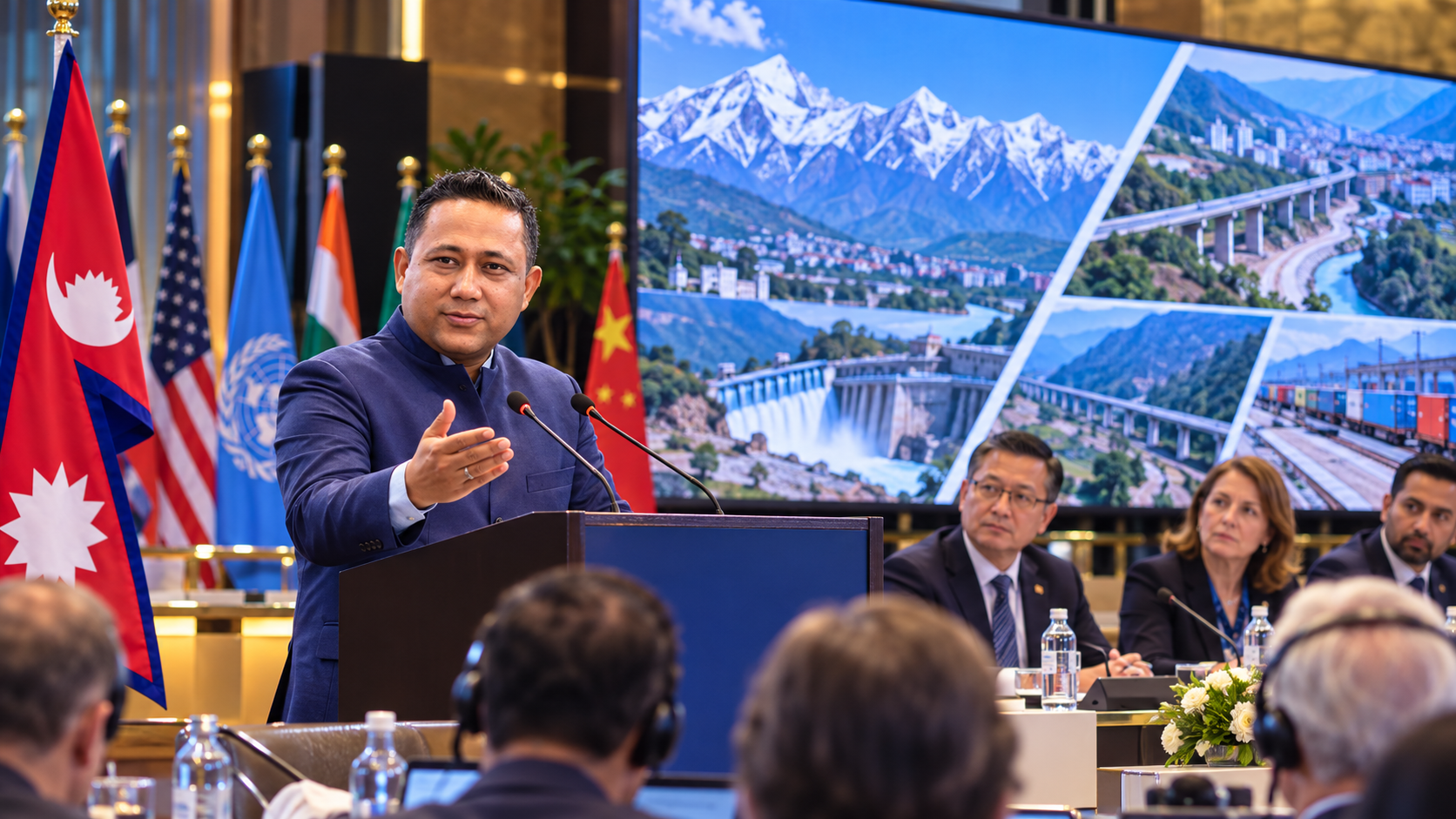
Speaking at the Asia Society on the sidelines of the 81st United Nations General Assembly, Khanal discussed the factors behind the rise of the Rastriya Swatantra Party (RSP), the emergence of a younger political class and the government’s approach to economic development and international relations.
The discussion came months after Nepal’s political landscape was significantly reshaped by a new electoral outcome following the Gen Z-led political movement.
Khanal attributed the political transition to years of instability, concerns over corruption and political patronage, limited economic opportunities and the increasing departure of young Nepalis for employment abroad.
He said Nepal’s young population had increasingly compared opportunities available elsewhere in Asia with the economic conditions at home.
According to Khanal, these factors contributed to the Gen Z movement and subsequently helped the RSP expand its political influence.
The foreign minister also described the new political leadership as being drawn largely from professional, business and social backgrounds rather than traditional political careers.
Khanal outlined what he described as an approach combining social priorities with economic pragmatism.
He said the government supports stronger social justice while favouring market liberalisation, fewer bureaucratic barriers and increased investment. Education, healthcare and social security remain part of the government’s broader social agenda.
The government has also set long-term economic ambitions, including reaching middle-income status within a decade and achieving developed-country status by 2050, Khanal said.
For the foreign minister, foreign policy should contribute directly to those domestic economic objectives by attracting investment, expanding trade and creating better-paying employment inside Nepal.
A central theme of Khanal’s remarks was Nepal’s geographical position between India and China.
Rather than viewing Nepal’s location solely as a constraint, he argued that the country could use its position to expand trade, investment, tourism and connectivity.
Khanal referred to this approach as “development autonomy”—using relationships with neighbouring countries and other international partners to widen Nepal’s economic choices while maintaining national policy independence.
He said Nepal’s objective should move beyond simply managing its position between two major powers and toward creating economic value through connections with both neighbours and markets beyond them.
Khanal described Nepal’s current relationship with India as excellent while acknowledging that bilateral relations have experienced periods of fluctuation.
He said the government is focusing more heavily on practical opportunities in trade, energy and connectivity.
Hydropower is a particularly important area. Nepal wants to increase electricity exports to India and Bangladesh while using access to relatively low-cost renewable electricity to encourage industrial investment.
Khanal also pointed to Nepal’s long and open border with India and the size of the Indian market as important economic advantages.
China was another major part of Khanal’s discussion.
He described China as Nepal’s second-largest trading partner and highlighted the potential for improved roads, tunnels, dry ports, aviation links, digital connectivity and eventually cross-border rail.
Khanal said Nepal’s cooperation with China would be guided by transparent financing, feasibility assessments and value-for-money considerations.
He also argued that stronger economic connections with China should not be viewed as incompatible with Nepal’s relationship with India.
The broader objective, he suggested, is to develop connections in multiple directions rather than treating Nepal’s northern and southern economic corridors as competing choices.
Khanal noted that Nepal signed a Belt and Road Initiative memorandum with China in 2017 and a framework agreement in 2024.
He said projects under the framework had not yet entered implementation and indicated that Nepal would evaluate cooperation according to financing conditions, feasibility and economic value.
The government’s broader connectivity strategy seeks to transform Nepal from a landlocked economy into what Khanal described as a more “land-linked” economy, with infrastructure judged by whether it facilitates the movement of goods, services, investment, tourists and opportunities.
Khanal also discussed Nepal’s relationship with the United States, describing Washington as a longstanding development partner.
He said Nepal is interested in increasing US investment and expanding economic engagement with Europe, Japan, ASEAN countries and Gulf states.
On security cooperation, however, Khanal indicated that Nepal does not strongly pursue security alliances, reflecting the country’s established foreign-policy sensitivities and geographical position.
Khanal repeatedly connected Nepal’s international relations with the country’s domestic economic objectives.
His message in New York was that diplomatic engagement should help Nepal expand markets, attract investment, develop infrastructure and generate employment.
The approach represents the government’s stated effort to place economic development and practical cooperation at the centre of Nepal’s relations with India, China, the United States and other international partners.
The New York discussion therefore offered an international audience a detailed account of how Nepal’s new government views its political transition, economic ambitions and position in a rapidly changing Asian environment.
Comments
0 comments
Loading comments...