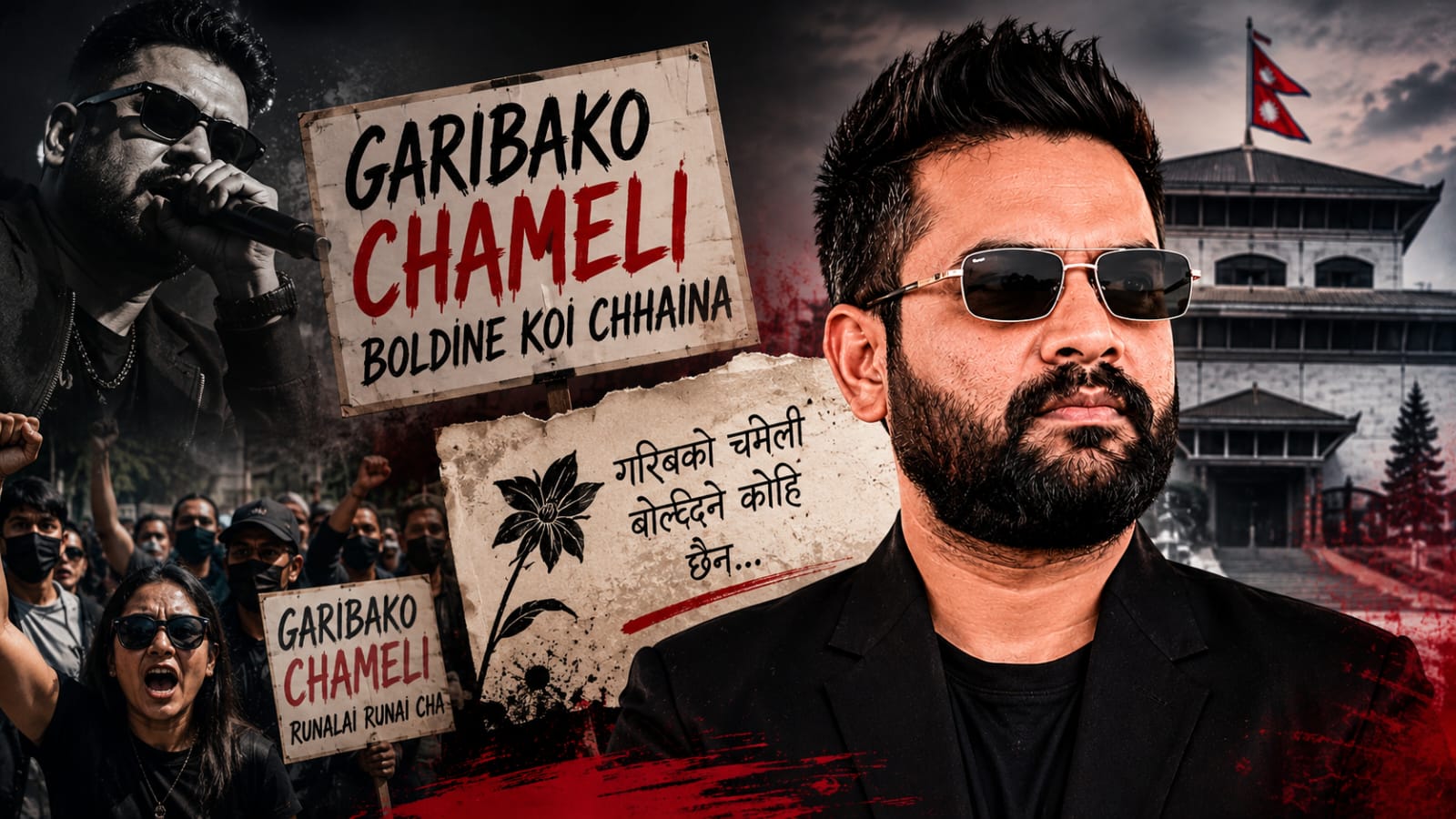
14 May Kathmandu A song once used by Balendra Shah to speak for the poor has now returned as a powerful protest anthem against his own government.
Across protest sites, Facebook posts, TikTok videos, and demonstrations in Kathmandu, the phrase “Garibako Chameli boldine koi chhaina” — “There is no one to speak for the poor” — is once again echoing through Nepal’s political landscape.
But this time, the song is not being used to criticize Nepal’s traditional political parties.
Instead, it is being directed at Prime Minister Balendra Shah himself.
A recent feature published by The Kathmandu Post explored how “Garibako Chameli,” a song deeply associated with Balen’s earlier image as a socially conscious rapper, has transformed into a symbol of growing public frustration over the government’s treatment of landless squatters and marginalized communities.
The development has created one of the most ironic political moments in recent Nepali politics: a protest anthem once used to challenge power is now being used to challenge the very person who popularized it.
🎤 From Rapper to Prime Minister
Before becoming one of Nepal’s most powerful political figures, Balendra Shah — popularly known as “Balen” — first became famous through music.
As a rapper, engineer, and outspoken public figure, Balen built a reputation for criticizing corruption, inequality, and political neglect through his songs.
One of the recurring themes in his music was the suffering of ordinary citizens, especially poor and marginalized communities ignored by the political establishment.
The phrase “Garibako Chameli” became strongly associated with that image.
The line originally comes from the revolutionary Nepali song “Chameli,” written by artist Raamesh and featured in the 1997 Nepali film Balidan.
In 2020, Balen reused the refrain in his own song “Balidan,” where he presented himself as a voice speaking against injustice and inequality.
At the time, many young Nepalis saw him as an authentic figure willing to challenge the country’s political elite.
That public image later became a major factor behind his political rise.
After his historic victory as Kathmandu mayor in 2022, Balen rapidly transformed from an anti-establishment cultural figure into one of Nepal’s most influential politicians.
By 2026, following dramatic political changes and youth-driven protests, he became Nepal’s prime minister.
⚠️ The Song Returns as Protest
The situation changed dramatically in recent weeks after protests erupted over the government’s actions against landless squatters in Kathmandu.
On May 2, demonstrators gathered at Maitighar Mandala — Nepal’s most symbolic protest location — to oppose what activists described as “inhuman” treatment of vulnerable communities facing eviction.
During the protest, participants recited poems and sang variations of “Garibako Chameli.”
One parody version performed during demonstrations directly criticized Prime Minister Shah:
> “Balendralai sunmathi sunai cha
Garibako Chameli runalai runai cha”
The protest version accused the government of becoming disconnected from the struggles of ordinary citizens.
The criticism intensified after asset disclosures revealed that Balen owned approximately 190 tola of gold, according to publicly released government records referenced during protests.
For critics, the contrast between Balen’s earlier anti-establishment image and his current position in power became impossible to ignore.
Social media quickly amplified the protests.
TikTok videos, protest posters, Instagram reels, and Facebook posts began circulating widely using modified versions of the song’s lyrics to criticize the government’s handling of poor communities and squatters.
The same digital culture that once helped elevate Balen politically was now becoming a platform for criticism against him.
🏚️ Squatter Evictions Trigger Public Anger
At the center of the controversy are eviction drives targeting landless squatters living in informal settlements.
The issue itself is not new.
Even during his tenure as Kathmandu mayor, Balen launched aggressive campaigns against illegal structures and settlements built on public land, particularly around riverbanks and urban spaces.
Supporters praised those actions as necessary for urban reform and environmental restoration.
Critics accused the government of prioritizing demolitions without offering adequate rehabilitation plans for displaced families.
The debate intensified again after recent eviction operations involving vulnerable residents, including:
Elderly citizens
Mothers
Children
Low-income families
Opposition figures and activists argued that the government was removing settlements without ensuring humane alternatives.
Several public figures began directly invoking “Garibako Chameli” while criticizing the government.
CPN-UML leader Ushakiran Timsina used the phrase publicly while condemning eviction policies and urging authorities to listen to the suffering of displaced communities.
Activists claimed the government’s actions contradicted the ideals Balen himself once promoted through music.
📱 Protest Culture in the Digital Era
One major reason the controversy spread so quickly is Balen’s unique relationship with digital culture.
Unlike traditional politicians, Balen rose to power partly through:
YouTube
Rap culture
Social media influence
Online youth communities
Viral political messaging
Experts say this has created a different type of political environment in Nepal, where music, memes, short videos, and online satire play a major role in shaping public perception.
Activists involved in the recent protests deliberately used music and parody because they understood its emotional and symbolic power.
According to activist Jasmine Ojha, political resistance itself is changing with technology and media culture.
“Resistance used to be physical,” she explained. “We believe the medium should change with the times.”
That shift is especially visible among younger protesters who now combine:
Protest music
TikTok activism
Viral slogans
Meme culture
Street demonstrations
into modern political expression.
Ironically, Balen himself helped popularize this style of political communication years earlier through rap music and digital activism.
Now the same methods are being used against him.
🎵 Why Music Matters in Nepali Politics
Music has historically played an important role in Nepal’s political movements.
From revolutionary folk songs during the democratic movements to modern rap music criticizing corruption and inequality, artists have often served as voices of political frustration.
“Garibako Chameli” itself carries emotional significance because it symbolizes the suffering of marginalized people ignored by those in power.
The song’s original creators viewed it as a revolutionary cultural expression focused on poverty and injustice.
Artist Raamesh, who originally wrote the song, recently commented on its renewed political relevance.
According to The Kathmandu Post, he said the song is appropriately being used to remind Balen of the values he once publicly represented.
“It is a way of saying: don’t change once you reach power,” he reportedly stated.
That message has resonated strongly online.
For many protesters, the issue is not simply about one eviction policy.
Instead, the song has become symbolic of a broader fear that political leaders may abandon their original ideals after gaining power.
👥 Public Opinion Remains Divided
Despite growing criticism, Balen Shah continues to maintain strong public support, especially among younger voters.
Supporters argue that Nepal desperately needs decisive leadership capable of challenging decades of inefficiency, corruption, and political stagnation.
They defend the government’s actions as necessary for:
Urban management
Rule enforcement
Infrastructure reform
Public land protection
Administrative discipline
Some supporters also accuse critics of romanticizing illegal settlements while ignoring long-term urban planning challenges.
Others believe opposition parties are exploiting the controversy for political purposes.
Meanwhile, critics argue strong governance should still protect vulnerable communities and maintain social justice principles.
This divide reflects a larger political tension currently shaping Nepal:
Demands for rapid reform
Versus concerns about social and humanitarian impact
The controversy surrounding “Garibako Chameli” has therefore become larger than a single song.
It now represents competing visions of what political change in Nepal should look like.
🌏 The Symbolism of Political Irony
Political analysts say the situation demonstrates one of the most powerful forms of political symbolism: when a leader’s own words return to challenge them.
Historically, protest movements often reuse slogans, speeches, songs, or promises previously made by political leaders themselves.
Experts say such moments are emotionally powerful because they expose contradictions between:
Political image
Public expectations
Governance reality
Balen’s rise was built heavily around authenticity and anti-establishment credibility.
That is why criticism using his own music carries unique symbolic weight.
The controversy also highlights how modern political identities are increasingly shaped not only by policy decisions, but also by culture, branding, and digital narratives.
In Nepal’s rapidly evolving political environment, songs and online symbolism now influence public discourse almost as much as formal speeches.
📉 Challenges Facing Balen’s Government
The growing criticism comes during a politically sensitive period for Prime Minister Shah’s administration.
His government continues facing pressure over:
Economic concerns
Governance expectations
Administrative reforms
Anti-corruption promises
Public service delivery
Youth expectations
Political analysts say maintaining public trust becomes especially difficult for leaders who rise to power as symbols of change.
Because expectations are extremely high, disappointment can also emerge more quickly.
Some experts argue the backlash surrounding “Garibako Chameli” reflects broader public anxiety over whether Nepal’s new generation of leaders can remain connected to ordinary citizens after entering power structures.
Others believe the criticism remains limited mainly to activist and online circles, while broader public support for Balen remains strong.
📌 Conclusion
“Garibako Chameli” has transformed from a revolutionary song into one of Nepal’s most powerful political symbols of 2026.
Once used by Balendra Shah to criticize inequality and defend marginalized communities, the song is now being sung against him by protesters accusing his government of abandoning those same ideals.
The controversy reflects more than political satire.
It highlights the growing tension between:
Reform and empathy
Power and accountability
Political symbolism and governance reality
As Nepal’s political environment continues evolving, the song’s message remains deeply relevant:
Who truly speaks for the poor once leaders rise to power?
For now, that question continues echoing from protest streets to social media feeds across Nepal.
Tags: Balen Shah, Garibako Chameli, Nepal Politics, Protest Music, Nepal Protest, Kathmandu Politics, Nepal Youth, Political Culture, Social Media Nepal, Balendra Shah
🌐 HamroBichar
📧 info@hamrobichar.com