One year after Nepal’s Gen Z movement transformed the country’s political leadership, many of the young people who were injured in the protests and families who lost loved ones say their own lives have changed little.
They say they are still waiting for proper medical treatment, compensation, employment opportunities, justice and implementation of commitments made by successive governments.
The central question emerging from the first anniversary is increasingly direct: If the movement changed who holds power, when will it change the future of the people who paid the highest price for it?
Among those still living with the consequences is Rakesh Mahato, a 25-year-old from Sarlahi who was shot during the Gen Z protests.
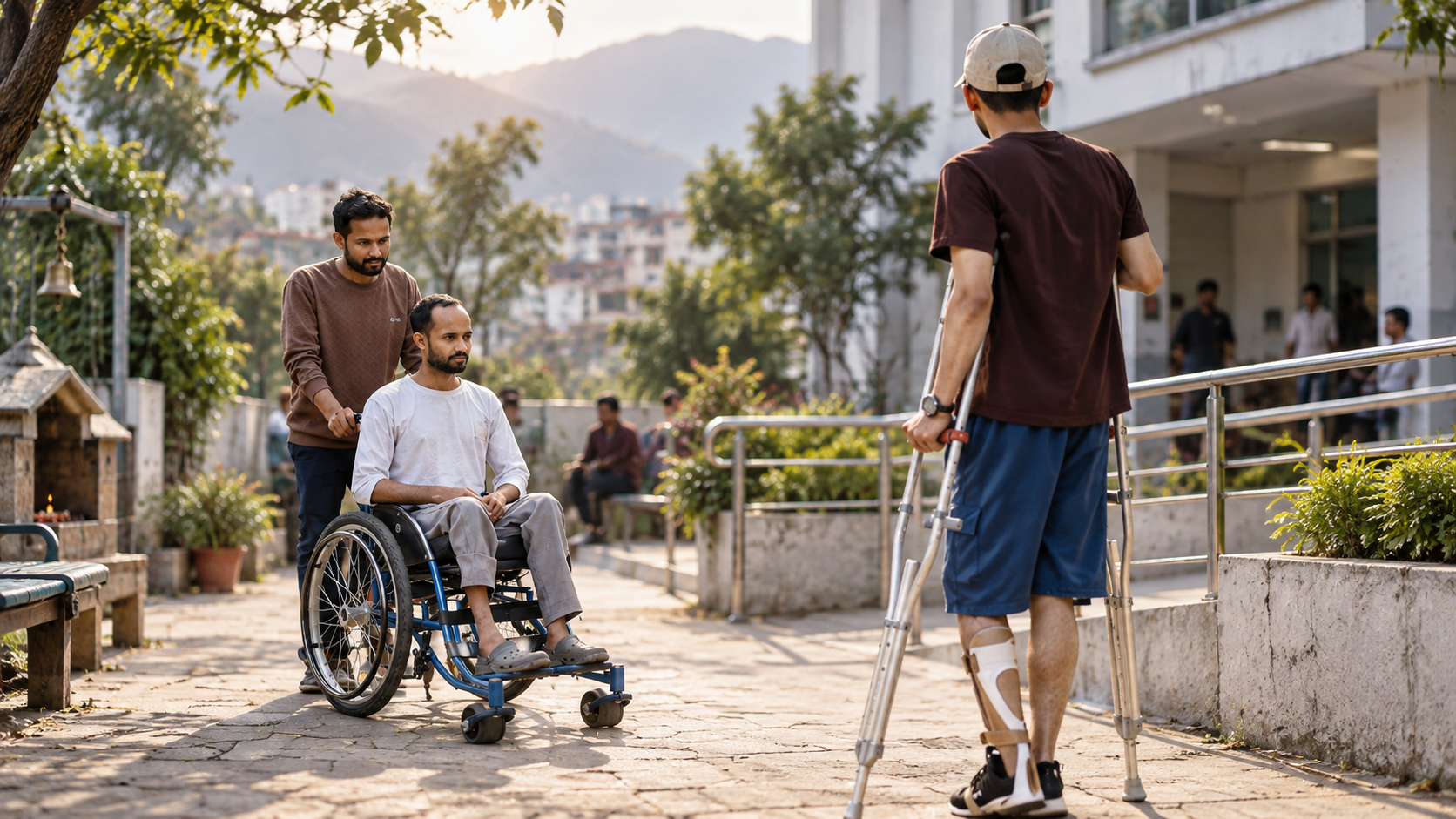
Mahato spent nearly a year receiving treatment after losing movement in the lower part of his body. He now uses a wheelchair and continues to hope that he will eventually be able to stand and walk again.
Before the movement, Mahato was studying for a bachelor's degree and preparing for the civil service examination. Despite his family's difficult financial situation, he had hoped to secure a government job and support his younger brother's education.
Instead, his life has been dominated by hospital visits and uncertainty.
He says he still wants answers about who ordered the shooting and why the police used live ammunition against protesters.
“Who fired at us and why? There has still been no investigation and no action against those responsible.”
The frustration is particularly painful because the political system changed dramatically after the protests, while his personal circumstances remain largely unchanged.
The Gen Z protests of September 2025 resulted in 76 deaths and 2,638 injuries, according to the report.
The movement eventually led to major political changes. An interim government was formed under former Chief Justice Sushila Karki, followed months later by parliamentary elections in which the Rastriya Swatantra Party secured a two-thirds majority.
Balendra Shah subsequently became prime minister, marking a dramatic shift in Nepal's political leadership.
For many injured protesters, however, the political transformation has not translated into a comparable transformation in their daily lives.
They say the faces in Singha Durbar have changed, but their own struggles remain tied to the days of the protests.
An agreement reached between the interim government and Gen Z representatives included commitments concerning the victims and their families.
The agreement envisioned relief and compensation, free medical treatment and psychosocial counselling, education, employment, social security and meaningful memorialisation of those killed.
It also called for mechanisms to investigate corruption, promote good governance and end impunity.
But injured protesters and families of those killed say implementation has been slow.
They argue that even basic commitments—such as full medical treatment and employment assistance—have not been delivered consistently.
For many survivors, medical care is still the most immediate problem.
Ravi Bhandari, 29, from Sindhuli, was shot in the leg during the movement. He continues to attend follow-up appointments but worries about how he will pay for treatment.
After receiving treatment at B&B Hospital, he says he was informed that further treatment would require payment.
The government says it prioritises treatment through public hospitals because private treatment can be expensive. Law Minister Sovita Gautam has said the government remains committed to providing free treatment within Nepal and will coordinate assistance where necessary, including for injured people receiving treatment in India.
The government had established a classification system for injured protesters based on the severity of their disabilities.
Under the system, those classified as extremely seriously injured receive a monthly allowance of Rs 18,000, seriously injured people receive Rs 9,000, while moderately and ordinarily injured people receive Rs 4,000 per month.
But survivors say these payments are insufficient even for basic living costs.
For people who cannot return to their previous occupations because of permanent injuries, the financial burden is much greater.
The difficulties extend beyond those who survived.
Ambika BK, from Udayapur, lost her husband, Santosh Bishwakarma, during the movement. She recently began working in an administrative position at the Nepal Electricity Authority's Ratna Park office.
Because the job is contractual, she says her income provides limited security. Much of her monthly earnings goes toward rent and food, leaving little for her children's education and healthcare.
She also says some people make hurtful comments about her employment, suggesting she received the job only because her husband died during the movement.
For a family already dealing with loss, such remarks have added another layer of emotional pain.
Gen Z activist leaders say the government's response has fallen short of the movement's expectations.
Sarishma Thapa, a Gen Z leader, said victims had to repeatedly pressure the government even to obtain identification cards for injured protesters.
She also questioned whether some injured people were genuinely being given meaningful employment or simply being placed in temporary positions.
According to her, some protesters remain in jail despite agreements that people who participated in the movement would not face prosecution simply for taking part.
The concerns reflect a broader complaint: that the government has recognised the political significance of the movement but has not adequately addressed the needs of the people who were injured during it.
Prakash Bohara, 29, from Dailekh, became one of the recognisable faces of the movement after being injured and photographed near the Federal Parliament.
He now walks with crutches and continues to require medical treatment. Four additional operations remain for the leg injured by a bullet during the protests.
Bohara spent months in hospital and later entered politics, becoming a proportional-representation candidate for the Rastriya Swatantra Party during the parliamentary election.
He was not elected.
He later contested for a central committee position at the party's general convention but was also unsuccessful.
Bohara says injured Gen Z protesters have little representation in Parliament or government, raising concerns that their concerns are therefore not being heard strongly enough.
Yet he says the injured will continue to question the government until their demands are addressed.
The delay in investigating the use of force has become one of the most sensitive issues for survivors.
A commission led by former Chief Justice Gauri Bahadur Karki investigated the violence and concluded that police had fired indiscriminately during the second day of the movement.
The report also found that live fire continued for hours before the curfew and that political and police leadership failed to take timely steps to stop it.
For injured protesters, the key question is now whether those findings will lead to accountability.
They say political change cannot be considered complete if the circumstances surrounding the deaths and injuries remain unresolved.
Law Minister Sovita Gautam has rejected the suggestion that the government has completely ignored Gen Z victims.
She says the government has been communicating with injured protesters and families of those killed and that arrangements are being made to institutionalise that dialogue through a proposed Gen Z Council.
According to Gautam, a coordination committee is working on the structure and responsibilities of the council. It is expected to consult injured protesters and families before submitting recommendations for its formation.
She acknowledged that victims may feel the process is taking too long but said the government needed time to establish mechanisms for implementing previous agreements.
She said the government is now working to move the process forward without further delay.
Dhiraj Joshi, who participated in discussions following the movement, said nobody joins a protest expecting to be injured, killed or honoured afterward.
But once people have suffered injuries or families have lost relatives, he argued, the state has a responsibility to fulfil its commitments.
For him, the deeper purpose of the Gen Z movement was not simply changing political leaders.
It was about accountability, transparency, good governance and ending corruption.
A year later, he says there is growing concern that the government itself may not be moving quickly enough toward those principles.
The most striking contrast of the Gen Z movement's first anniversary is between political transformation and personal hardship.
The movement succeeded in changing Nepal's political leadership. A new generation gained unprecedented influence, established political forces were challenged, and a new government emerged from the political upheaval.
But for those who were shot, injured or lost family members, the promised transformation remains incomplete.
They are still asking for treatment.
They are still waiting for jobs and compensation.
They are still seeking justice.
And they continue to ask whether the political system that changed after their sacrifice will eventually change their own lives.
One year after Gen Z changed the balance of power in Nepal, the question is no longer simply who governs the country.
For the movement's injured survivors and bereaved families, the more important question is:
When will their future change?
HamroBichar will continue to follow the government's implementation of commitments to Gen Z victims, injured protesters and families of those who lost their lives during the movement.
Tags: Gen Z Movement, Nepal Politics, Gen Z Victims, Gen Z Injured, Nepal Government, Balendra Shah, Good Governance, Political Reform, Justice, Gen Z Protest
Comments
0 comments
Loading comments...