One year after Nepal’s Gen Z movement shook the country’s political establishment, the physical scars of the September 2025 unrest are gradually being repaired, but the deeper questions raised by the movement remain unresolved.
The protests of September 8 and 9, 2025, transformed Nepal’s political landscape. They brought young people onto the streets over corruption, poor governance, nepotism and a lack of accountability, while the government’s response and the violence that followed left extensive damage to public and private property.
76 people lost their lives during the movement. A year later, damaged buildings and infrastructure are being reconstructed, but demands for good governance, accountability and institutional reform remain at the centre of public debate.
What began as a youth-led protest rapidly developed into one of Nepal’s most consequential political crises in recent years.
The movement was driven by widespread frustration among young Nepalis over corruption, political privilege, nepotism, unemployment and what many viewed as the failure of established political parties to deliver meaningful reform.
The unrest eventually forced the resignation of then-Prime Minister KP Sharma Oli and opened the way for an interim government led by former Chief Justice Sushila Karki.
The political changes that followed ultimately culminated in elections and a major reshaping of Nepal's political landscape.
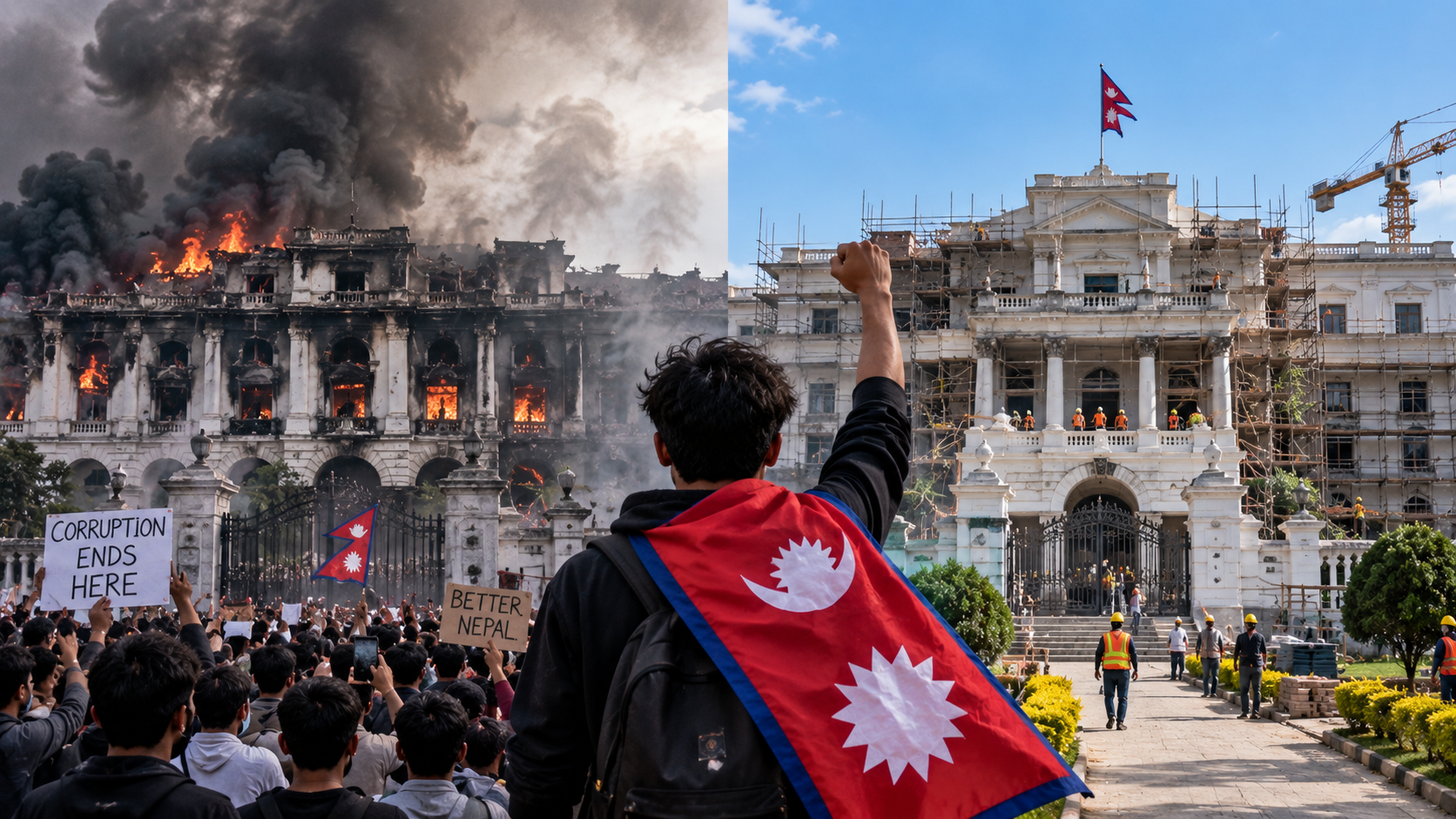
The violence of September 2025 caused extensive destruction across Kathmandu Valley and other parts of the country.
Among the structures affected were Singha Durbar, the Supreme Court, ministers' residences, political party offices, commercial buildings and other public facilities.
The destruction extended beyond government property. Businesses, hotels and other privately owned structures were also damaged or burned.
Kantipur highlights several major structures whose appearance has changed significantly over the past year, including Singha Durbar, the ministerial residences at Bhaisipati, the Hilton Hotel in Naxal, Bhat-Bhateni Supermarket, the Supreme Court and the Sunrise Conference Centre in Godavari.
The physical reconstruction has therefore become an important part of the country's post-movement recovery.
A year later, many of the places damaged during the unrest no longer look the same.
Repair and reconstruction work has transformed previously burned or damaged structures. Government offices and other institutions have been working to restore facilities and resume normal operations.
But rebuilding walls and offices is only one part of the recovery.
The larger challenge is whether the political and institutional system can address the grievances that brought young people onto the streets in the first place.
The central questions remain familiar: Has governance improved? Is corruption being tackled more effectively? Has political accountability increased? And has the culture of nepotism that angered many young Nepalis genuinely changed?
The political transformation that followed the protests created enormous expectations.
Young voters became an increasingly influential force, while established political parties faced growing pressure to respond to demands for transparency and better governance.
The subsequent rise of new political forces demonstrated that the movement had consequences far beyond the streets.
Yet one year later, activists and observers continue to question whether the changes have gone deep enough.
Nepal News reported on the anniversary that many Gen Z activists believe the government's performance has not fully matched the expectations created by the uprising. The debate has shifted from whether change was necessary to whether the change delivered so far is sufficient.
The anniversary is also a reminder of the human cost of the movement.
Families of those killed continue to remember their loved ones, while survivors of the protests carry physical, emotional and financial consequences.
A first-anniversary commemoration was held at Kathmandu's old Parliament building on September 8, with government representatives, lawmakers, activists, civil society members and families of victims paying tribute to those who died.
Former interim prime minister Sushila Karki said the country must ensure that such a situation does not happen again and stressed that good governance and accountability are essential for political stability.
The contrast between physical reconstruction and institutional reform is perhaps the defining theme of the movement's first anniversary.
Burned buildings can be repaired. Damaged offices can be reconstructed. Roads and public facilities can be restored.
But rebuilding public trust is considerably more difficult.
The Gen Z movement raised demands that cannot be resolved simply through construction projects. Its deeper legacy will depend on whether Nepal's political institutions become more transparent, accountable and responsive to citizens.
One year on, Nepal has rebuilt much of what was physically destroyed. The harder question is whether it has begun rebuilding the relationship between citizens and the state.
As the country marks the anniversary, the debate has therefore moved beyond what was burned and what has been rebuilt to a more fundamental question: what has actually changed?
HamroBichar will continue to follow the political and institutional changes emerging from Nepal's Gen Z movement and its long-term impact on the country's future.
Tags: Nepal Gen Z Movement, Gen Z Protest, Nepal Politics, KP Sharma Oli, Sushila Karki, Balen Shah, Political Reform, Nepal Reconstruction, Good Governance
Comments
0 comments
Loading comments...