Internal pressure for leadership change is intensifying within Nepal’s CPN-UML, with grassroots leaders and younger party figures increasingly calling for a generational transition after the party’s poor electoral performance and the political upheaval triggered by the Gen Z movement.
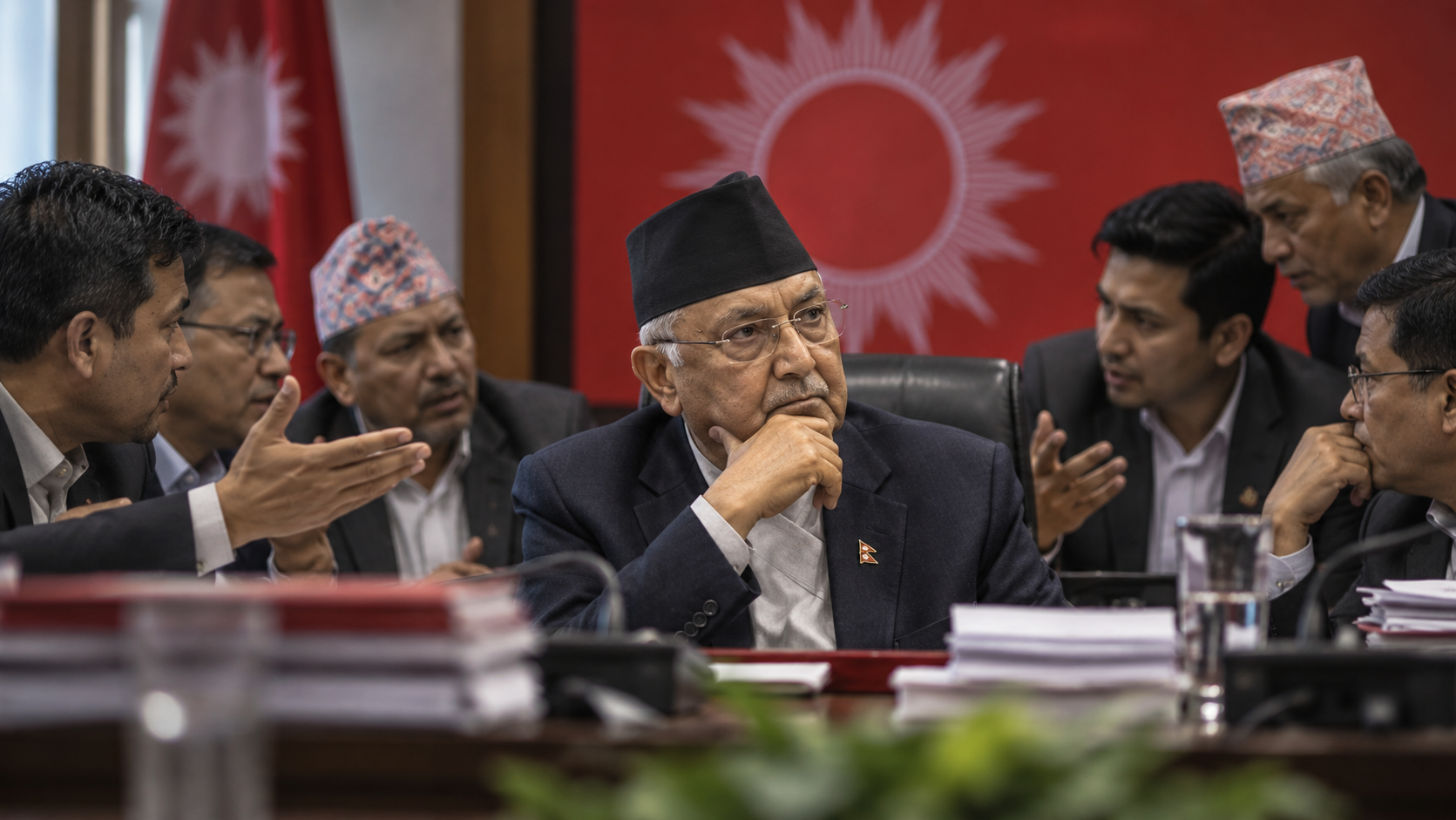
The debate has placed party chair KP Sharma Oli at the centre of growing criticism, as sections of the UML argue that the party needs organisational restructuring and new leadership to reconnect with voters.
The push for change comes after UML suffered its worst electoral setback in recent history in the March 5 election, winning only 25 seats, compared with 79 seats in the 2022 election.
Calls for change are not limited to senior UML leaders. Party activists and leaders associated with the younger generation have increasingly argued that the organisation needs to move beyond the leadership structure dominated by Oli and other long-serving figures.
Some leaders have advocated a special general convention to determine a new direction for the party, while others have called for a broader generational transition.
The debate has reportedly gained momentum among third-generation UML leaders, including figures such as Yogesh Bhattarai, Pradeep Gyawali, Binda Pandey, Gokarna Bista, Suhang Nembang and others.
Younger leaders argue that both the first and second generations should make room for a new leadership team capable of responding to changing political realities.
The March election significantly weakened UML's position.
The party secured only nine first-past-the-post constituencies and 16 proportional-representation seats, leaving it with 25 seats overall. This was a dramatic decline from the 79 seats UML had won in 2022.
The defeat has intensified questions over whether the existing leadership can rebuild the party's support base.
For critics within UML, the election result is evidence that the party needs more than an organisational adjustment—it needs a significant political and leadership rethink.
Oli, however, has shown little willingness to step aside or endorse an immediate leadership review.
In August, he rejected calls for a special convention or a National Representative Council meeting, describing such demands as premature. He argued that the current leadership had been elected by the party's 11th general convention in December and that there was no justification for an immediate leadership review.
This has created a growing divide between those demanding rapid reform and the leadership camp seeking to preserve continuity.
The internal debate has now produced competing proposals for the party's future.
General Secretary Shankar Pokharel prepared a 65-page report based on suggestions collected from across the country. According to recent reporting, the report includes criticism of the current leadership and arguments that Oli should take responsibility for the party's situation.
Vice-chair Ram Bahadur Thapa 'Badal', however, has prepared a separate report defending Oli's leadership. The 39-page document reportedly argues against removing Oli and rejects the idea that the party's problems can simply be attributed to his leadership.
The existence of competing reports highlights the seriousness of the disagreement within the party.
Thapa's report argues that the Communist movement under Oli's leadership achieved a high level of unity and progress.
It also rejects criticism of the decision to remove the party's 70-year age limit and two-term limit for the chairperson, arguing that such provisions are not necessarily appropriate for every political party.
The report therefore represents a clear attempt to defend continuity under Oli rather than opening the way for an immediate leadership transition.
A separate report said Thapa has been preparing the latest task-force document in consultation with Oli, with the document expected to emphasise strengthening and unifying UML under its current leadership.
The strongest challenge to the existing structure is coming from younger leaders.
Some have argued that UML needs to hand responsibility to its third generation instead of continuing with the same leadership model.
Suhang Nembang, one of the younger UML figures, has openly raised the issue of leadership change and reportedly discussed it within parliamentary party meetings and other forums.
Party insiders say, however, that some younger leaders remain cautious about speaking openly because they fear disciplinary action or even expulsion.
That fear itself has become part of the debate over internal democracy within UML.
The leadership dispute also has a longer history.
Just before the Gen Z uprising, UML amended its statute, removing the 70-year age limit and two-term limit for the party chairperson. The change allowed Oli to pursue another term and strengthened his position at the top of the party.
The move subsequently became controversial, particularly after UML's electoral defeat and the rise of new political forces.
For critics, the question is whether a party seeking renewal can convincingly present itself as an agent of political change while retaining the same leadership.
The pressure on UML cannot be separated from the broader political transformation following the September 2025 Gen Z movement.
The uprising brought down the Oli-led government and was followed by an interim administration, the dissolution of the House and fresh elections.
In the March election, the Rastriya Swatantra Party emerged as the dominant force, while UML suffered a major setback. Oli himself was defeated by RSP senior leader Balendra Shah.
The results have forced traditional parties to reconsider how they organise themselves and communicate with a younger electorate.
The coming months could determine whether the current pressure develops into an open leadership contest.
Those seeking change want a special convention or another party-level mechanism through which the leadership can be reviewed.
Oli's supporters, meanwhile, argue that removing the chairperson will not automatically solve UML's problems and that the party instead needs unity, organisational strengthening and a clearer political strategy.
The dispute is therefore about more than one individual. It reflects a larger question facing UML: Can the party recover under its existing leadership, or does rebuilding require a generational transition at the top?
For now, Oli remains firmly at the centre of the party, but the growing grassroots demand for change suggests that the debate over his political future is unlikely to disappear.
HamroBichar will continue to follow the internal developments within CPN-UML and the evolving debate over its leadership and organisational restructuring.
Tags: KP Sharma Oli, CPN-UML, UML Leadership, Nepal Politics, Leadership Change, Shankar Pokharel, Ram Bahadur Thapa, Gen Z Movement, Nepal Election 2026, UML Crisis
Comments
0 comments
Loading comments...