
Telecom Emerging as Nepal’s Frontline Defense Against Climate Disasters
By Ranjeet YadavPublished: May 17, 2026Updated: October 10, 2026Reading time: 5 min
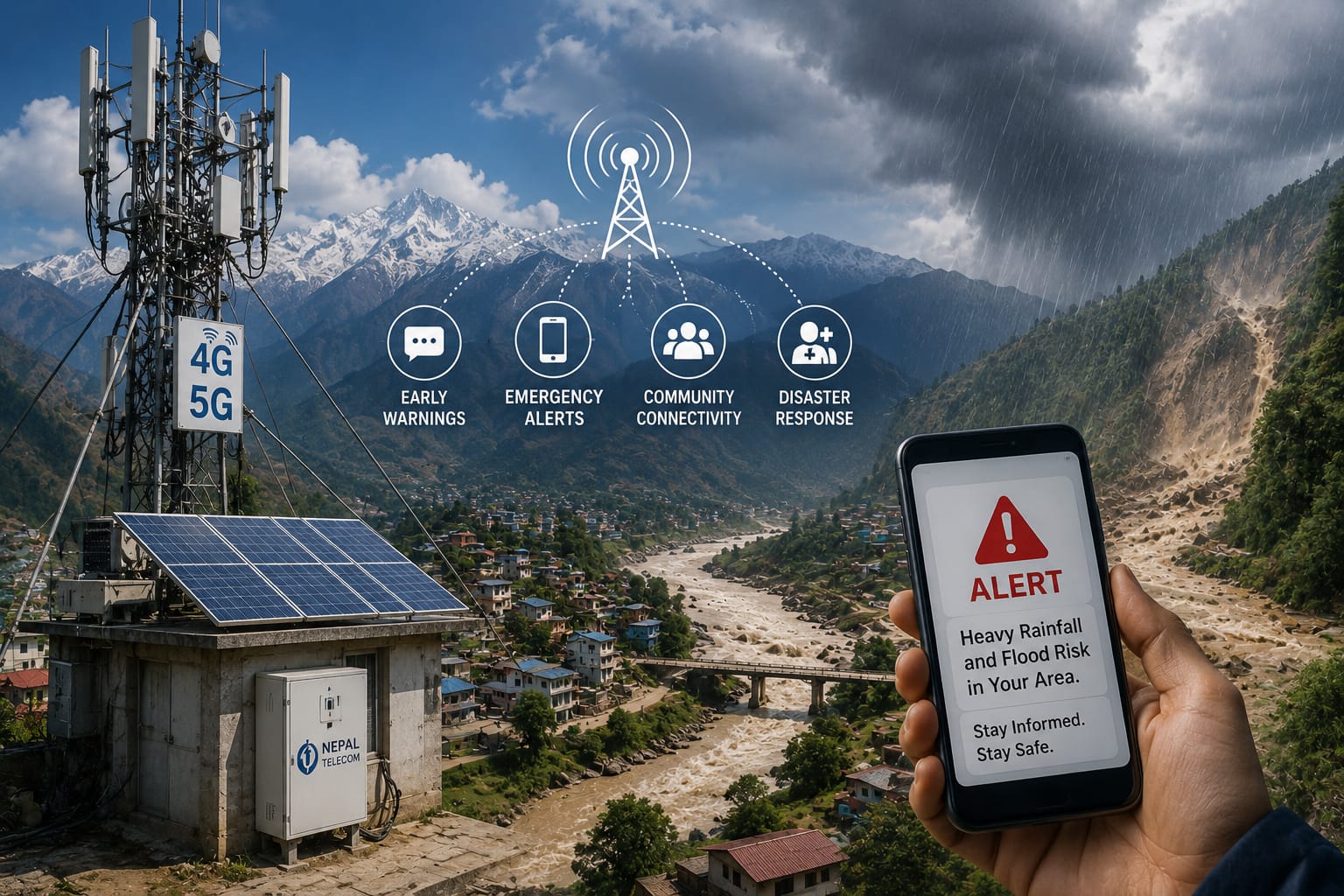
17 May Kathmandu As climate change worsens floods, landslides, storms and extreme weather in Nepal, experts are calling increasing attention to a sector often sidelined in climate discussions – telecommunications.
From emergency alerts to disaster communication, remote connectivity and climate resilience, Nepal’s telecom infrastructure is now seen as one of the country’s most critical frontline systems for disaster preparedness and development.
📡 Telecom: More Than Just Communication
In the past, telecommunications in Nepal have mainly concentrated on:
Wireless connection
- Internet access.
- Communications services
But experts now say telecom systems have become critical national infrastructure amid climate emergencies.
Both are increasing in Nepal due to climate-induced disasters:
- How often
- Strength
including:
-Flooding
- Rockslides
- Risks of glacial lake outburst
- Heavy rainfall
- Heat waves
Such disasters often affect communication networks, particularly in Nepal’s difficult Himalayan terrain.
But telecom networks are also becoming powerful tools for:
- Early warning systems
- Coordination of emergency
- Rescue communications
Public safety alerts
- Climate knowledge distribution
⚠️ Nepal is very vulnerable to climate disasters.
Nepal is still one of the most climate-vulnerable countries in the world, even though it contributes very little to global greenhouse gas emissions.
In recent years,
- Floods of record
- Torrential rain
-Extreme heat
- Rockslides
-forest fires
Climate change and changing atmospheric systems are making weather patterns in Nepal increasingly unstable, meteorologists say.
The pressure on the climate is increasing, which makes reliable communication infrastructure during emergencies all the more important.
📲Nepal Telecom Early Warning System
Among Nepal’s telecom-based disaster initiatives, one of the most important is the collaboration between:
- Nepal Telecom - (NT)
- Department of Hydrology and Meteorology (DHM)
Nepal Telecom has been providing free mass SMS alerts to people residing in disaster-prone areas since 2016.
The alerts give:
- Flood Alerts
- Weather forecasts
- Disaster risk data
- Real-time emergency alerts
During the floods of 2017, SMS warnings reportedly helped evacuate more than 4,000 people in the Babai River region alone.
Such systems, if expanded nationwide, could drastically cut disaster casualties, experts say.
🌐 Linking Nepal’s Remote Regions
The mountainous geography of Nepal makes the development of telecom infrastructure very challenging.
Many private telecom operators depend heavily on:
- Networks of fiber
- Ground infrastructure
Nepal Telecom is increasingly using:
- VSAT (Very Small Aperture Terminal) technology
- Satellite communication systems
to serve the remote Himalayan and hill areas where infrastructure development is difficult with traditional infrastructure.
The connectivity in remote areas is not just about communication, but also about: Analysts say
- Emergency response
- Access to healthcare
- Schooling
- Economic Participation
🏔️ What we learned from the 2015 earthquake
Telecom infrastructure was especially critical during Nepal’s devastating earthquake of 2015.
The quake:
- Disruption of communication systems
- Infrastructure destroyed
- Severe network congestion led to
- National emergency coordination was hampered
Now experts say Nepal needs to do better:
- Communication systems for emergencies
- Infrastructure backup
Mobile alerting technology
- Resilience of satellite communications
before another catastrophe strikes.
📢 Campaign for Improved Cell Broadcast Alerts
Now, telecom experts are promoting the use of modern “cell broadcast” systems for disaster communication in Nepal.
Unlike standard SMS alerts, cell broadcast technology can do the following:
- Reach thousands of phones at the same time
- Congestion in the network
- Work on devices from 2G to 5G
- Receive emergency alerts relevant to your location
Experts say systems like these could dramatically improve emergency preparedness during:
- Earthquake activity
- Floods, Flash
- Rockslides
- Intense weather
☀️ Green Telecom & Sustainable Infrastructure
Telecom companies are starting to roll out climate-friendly infrastructure, too.
Nepal Telecom has reportedly begun deployment of:
Solar hybrid power systems
- Energy efficiency of telecom towers
- Eco-friendly telecom infrastructure
particularly in remote base stations to lessen dependence on diesel and reduce carbon emissions.
This is in keeping with Nepal’s broader goals for climate adaptation and sustainability.
🌍 Climate Change Now a Development Issue
More and more experts are warning that climate change is no longer just an environmental issue — it is also a:
- Development challenge
- Financial risks
- Public safety concern
Climate disasters impact:
– Agriculture
- Wellbeing
- Infrastructure
- Schooling
- Livelihood
- Migration trends
The impact is often most dire in poor, geographically isolated communities.
Experts say telecommunications can help lessen vulnerability through better:
- Access to information
- Coordination of -
Known to the public
- emergency reaction
📌 Summary
Climate threats facing Nepal are growing and increasingly erratic, and telecommunications are emerging as one of the country’s most important tools for resilience and disaster preparedness.
From flood alerts and remote connectivity to emergency coordination and sustainable infrastructure, the telecom sector is no longer just facilitating communication – it is becoming a key pillar of Nepal’s climate adaptation strategy and future development.
Tags: Nepal Telecom, Climate Change Nepal, Disaster Preparedness, Early Warning System Nepal, Telecom Infrastructure Nepal
🌐 https://hamrobichar.com/
📧 info@hamrobichar.com
Related Articles

Comments
Join the discussion
0 comments
Loading comments...