
Interpol’s Rejection in Deuba Case Raises Serious Questions Over Nepal’s Investigation Process
By Ranjeet YadavPublished: May 17, 2026Updated: October 16, 2026Reading time: 4 min
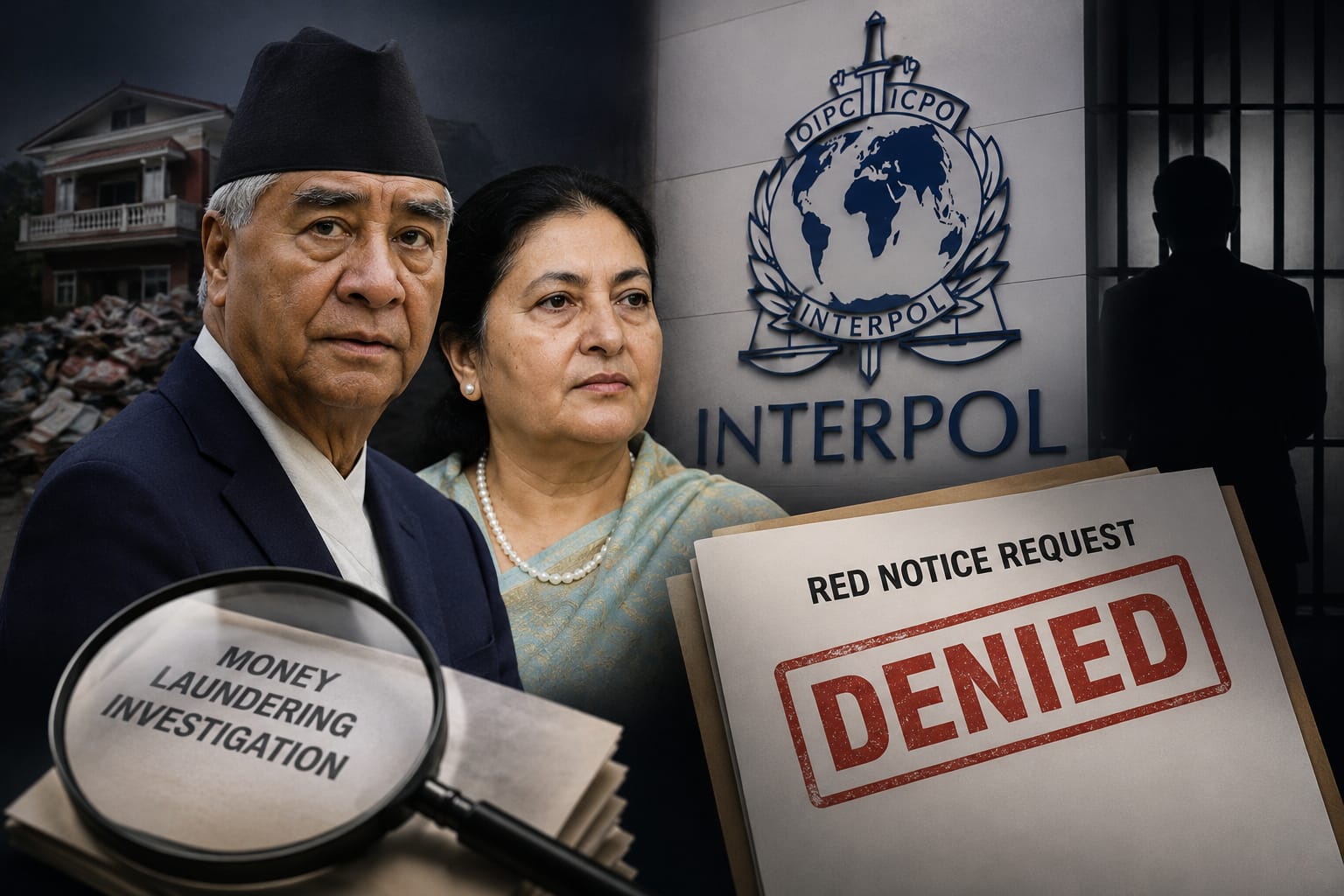
17 May Kathmandu Nepal’s investigation procedures, legal preparedness and handling of high-profile money laundering cases have come under increasing scrutiny after Interpol refused to issue Red Notice against former Prime Minister Sher Bahadur Deuba and former Foreign Minister Arzu Rana Deuba.
Legal experts and former investigators are now questioning whether Nepal’s investigating agencies failed to meet international legal standards in seeking international police cooperation against one of the country’s most politically influential families.
What’s Happening?
April 2026: Nepal Police issue arrest warrants for the Deuba couple in connection with an ongoing investigation into money laundering. Authorities sought an Interpol Red Notice to assist with international tracking and potential detention.
But Interpol reportedly turned down the request, citing “insufficient” grounds presented by Nepali authorities to support an international notice.
Interpol requested, according to officials familiar with the case:
- The legal grounds of the investigation
- Nature of the charges
- Procedural aspects of the money laundering investigation.
- whether the legal thresholds had been properly reached
Interpol later received additional clarification and supporting information from authorities but officials say they have yet to receive a final response on the second request.
⚖️ Legal Experts Sound the Alarm
Now the incident has raised wider concern among legal analysts who say the rejection may point to deeper procedural shortcomings in Nepal’s investigation system.
Experts say international bodies such as Interpol need
- No criminal grounds
- Good supporting evidence
- Compliance with proper procedures
- Legal documents that are clear
before issuing politically sensitive Red Notices.
Several observers warned that ill-prepared international requests can:
- Undermining institutional credibility
- doubt the quality of the investigation
- Generate perceptions of political targeting
especially in cases concerning senior political figures.
🏛️ A politically fraught case
The inquiry was initiated following violent protests by Gen Z in September 2025 when protesters attacked the Deuba residence in Budhanilkantha. And videos of large amounts of cash being taken out of the property and burned only added to the public fascination.
In the wake of the unrest, the Department of Money Laundering Investigation commenced investigations into:
- Sher Bahadur Deuba
- Arzu Rana Deuba
-Other former top political leaders
on charges of illicit enrichment and suspicious financial transactions.
The case soon became one of the most politically sensitive investigations in Nepal in recent years.
🔍 Questions on how to structure an investigation
Critics also mention institutional complications surrounding Nepal’s Department of Money Laundering Investigation (DMLI).
The department has swung between:
- Ministry of Finance
- Prime Minister’s Office
several times in the last couple of years depending on the political winds.
Some legal observers argue that frequent restructuring and political influence can weaken:
- Autonomy of institutions
- Continuity of investigation
- International Trust
financial crime investigations.
🌐 What is Interpol?
Interpol Red Notices are not arrest warrants, but they are powerful international requests asking member countries to:
- Search
- See
- To detain provisionally
persons wanted in connection with legal action or extradition procedures.
Such notices are politically sensitive and Interpol exercises strict scrutiny in cases where:
- Politicians.
- Former heads of state
- Possible political disputes
Experts say Interpol is particularly reluctant to become involved in politically motivated prosecutions.
⚠️ Political Debate Tightening
The rejection has since fuelled competing political narratives across Nepal.
Supporters of the probe maintain:
- The case should continue by itself
- Rejection abroad is not per se a reason to invalidate domestic investigations
In the meantime, critics say the Interpol response reveals:
- Bad legal preparation
- Potential procedural shortcuts
- Politicisation of probe agencies
Under the new government of Prime Minister Balendra Shah, the controversy is likely to further polarise Nepal’s already polarised political environment.
🧠 Broader Questions on Nepal’s Institutions
The incident has also revived wider debate around the Deuba case itself.
- Legal certainty”
- Professionalism of institutions
- Trust of anti-corruption
- International cooperation in law
Some analysts caution that agencies need to do better if Nepal is to get stronger international cooperation in financial crime investigations:
Documentation quality
- Legal uniformity
- Evidence processing
- Autonomy of institutions
📌 Summary
Interpol’s rejection of a Red Notice against Sher Bahadur Deuba and Arzu Rana Deuba has become more than a procedural setback.
The incident is now raising broader national questions about how politically sensitive investigations are managed in Nepal, whether legal institutions meet international standards and how credibility can be maintained in high-profile anti-corruption and money laundering cases.
Tags: Sher Bahadur Deuba, Interpol Nepal, Money Laundering Nepal, Nepal Politics, Arzu Rana Deuba
🌐 https://hamrobichar.com/
📧 info@hamrobichar.com
Related Articles


Comments
Join the discussion
0 comments
Loading comments...