
Nepal Flood Rescue Enters Critical Phase as Hundreds of Hydropower Workers Remain Missing
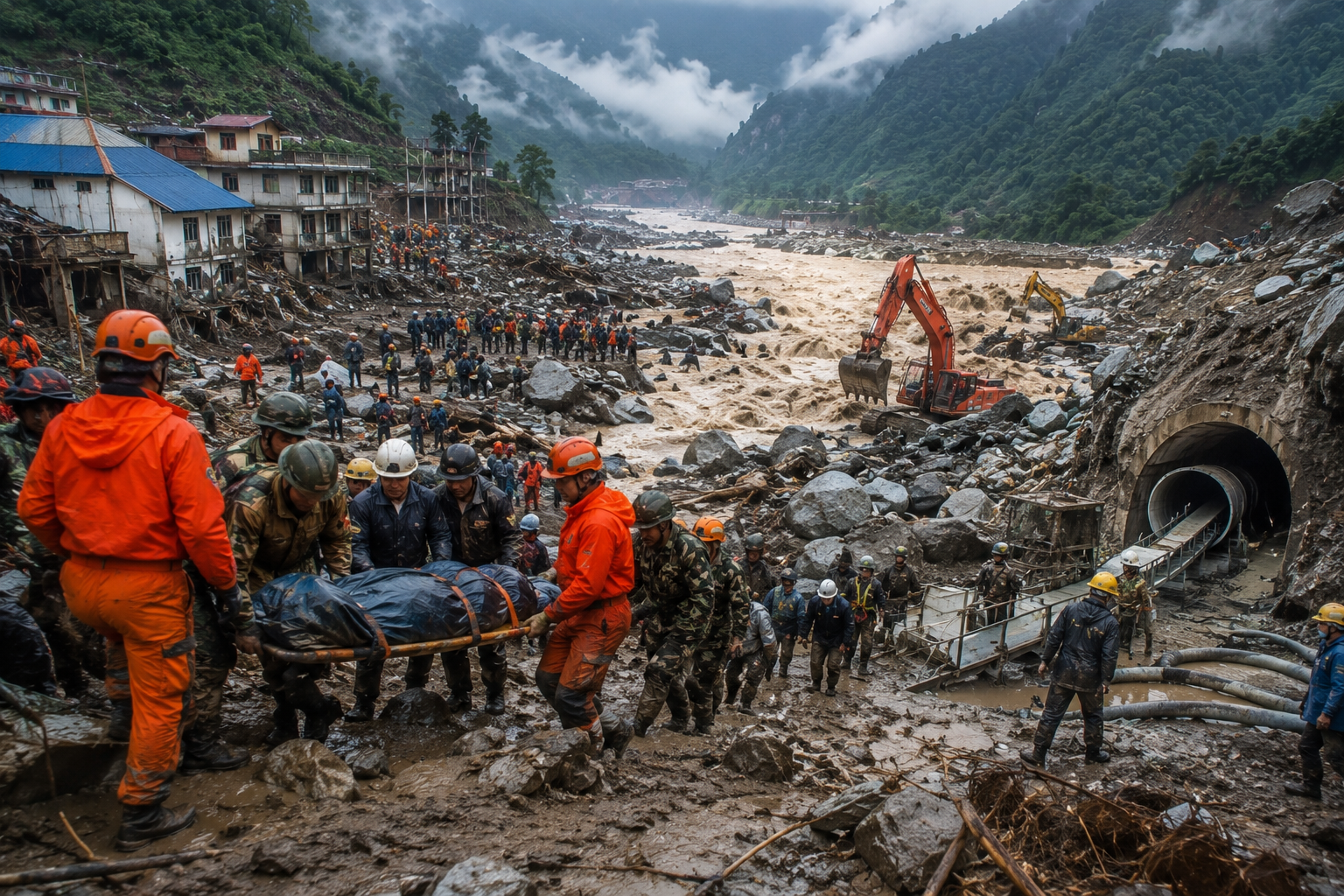
More than a week after the devastating Bhotekoshi flash flood tore through Nepal’s Himalayan valleys, families of hundreds of missing hydropower workers are still waiting for news.
Rescue teams are now using controlled explosions, excavators and other heavy equipment to break through enormous amounts of mud and rock blocking hydropower tunnels in Rasuwa and Nuwakot.
The scale of the disaster has become clearer with each passing day. Nepal’s death toll has now crossed 1,000, while around 4,000 people remain missing, according to the latest reporting. More than 11,000 people have been rescued so far.
Families refuse to give up hope
For families waiting outside rescue centres and hospitals, every passing hour brings a mixture of hope and fear.
Many workers were inside or near hydropower projects when the flood swept through the region on August 26. Some families believe their relatives could still be alive inside underground tunnels where the floodwaters and debris may have provided some protection.
BBC reported that rescuers have been blasting into hillsides and pumping air into tunnels in an attempt to reach workers believed to be trapped underground.
Some relatives have criticised the pace of the rescue operation, arguing that precious time is being lost while workers may still be waiting underground.
Nearly 900 people missing from hydropower projects
The hydropower sector has become one of the most difficult parts of the rescue operation.
According to data from the Independent Power Producers’ Association, Nepal, 894 people remain unaccounted for across 11 hydropower projects in Rasuwa and Nuwakot. At the 216MW Upper Trishuli-1 project alone, 573 people are still reported missing. Around 300 of them are believed to have been working inside tunnels, although authorities have not yet established exactly where everyone was when the flood struck.
Other heavily affected projects include Upper Trishuli-3A, Upper Trishuli-3B, Chilime, Langtang Khola, Mailung Khola and Rasuwagadhi.
The disaster has therefore become not only a humanitarian emergency but also a major crisis for Nepal’s hydropower industry.
Rescuers face a mountain of mud and rock
Reaching the missing workers is proving extraordinarily difficult.
The flood carried huge quantities of rock, mud and debris into the valleys and underground structures. In some locations, entrances to tunnels have effectively disappeared.
Nepali Army engineers have been using controlled blasts and heavy machinery to create access routes. Rescue teams have also been pumping water and air into underground areas in the hope of finding survivors.
Australian tunnelling expert Arnold Dix, who has been advising the rescue effort remotely, described the destruction as resembling a “lunar landscape”, with boulders reportedly larger than houses blocking access routes.
International teams join Nepal’s rescue effort
The scale of the disaster has prompted international assistance.
Teams and expertise from China, India and South Korea, among others, are supporting Nepal’s rescue and recovery operations. Assistance includes tunnel-rescue expertise, drones, forensic support and specialised equipment.
South Korea has announced the deployment of a 44-member disaster-relief team following Nepal’s request for additional search-and-rescue support.
The international involvement reflects the technical difficulty of reaching people trapped beneath massive quantities of debris.
A disaster that changed Nepal’s hydropower debate
The flood has also raised difficult questions about Nepal’s rapid expansion of hydropower infrastructure in mountainous river valleys.
Hydropower is one of Nepal’s most important economic opportunities, with the country hoping to increase electricity generation and exports to neighbouring India.
But the August 26 disaster damaged multiple hydropower projects and exposed the risks faced by infrastructure built in steep and increasingly hazard-prone Himalayan terrain. Reuters estimates that 431MW of generating capacity has been affected, while nearly 900 people are missing from 11 damaged or under-construction projects.
Experts are now likely to face renewed questions about whether disaster risks, glacier instability and changing Himalayan conditions have been adequately incorporated into infrastructure planning.
Glacier collapse believed to have triggered the disaster
Scientists increasingly believe the catastrophic flood was triggered by a glacier collapse, rather than being simply a conventional monsoon flood.
The collapse sent huge quantities of ice, rock and debris into the river system, creating conditions for an enormous downstream surge. The event highlights the growing risks associated with rapidly changing Himalayan environments.
Nepal’s Prime Minister Balendra Shah has described the disaster as one of the largest disasters in the Himalayan region and linked the growing risks to climate change.
The human cost continues to emerge
The flood has left thousands of families searching for loved ones.
In Rasuwa and Nuwakot, survivors have described fleeing with only the clothes they were wearing. Some families lost multiple relatives in a matter of minutes.
Meanwhile, hundreds of unidentified bodies have been recovered from rivers and debris. Authorities have begun using DNA collection and temporary burial procedures to manage the large number of unidentified victims.
The tragedy is particularly painful for families who still do not know whether their relatives are alive or dead.
The race against time
For the rescuers working inside the damaged hydropower tunnels, the coming days are critical.
Every tunnel presents a different challenge. Some are filled with mud and water, while others are blocked by enormous rocks. Rescue teams must balance the urgency of reaching possible survivors with the danger of further collapses and unstable terrain.
For families waiting outside, however, the message remains simple: do not stop searching.
As heavy machinery continues digging through the remains of Nepal’s hydropower infrastructure, the country waits for news from those still missing.
The flood has already become one of Nepal’s worst disasters in recent memory. The search for those still unaccounted for may determine how much more painful that toll becomes.
HamroBichar will continue to update this story as verified information from authorities and rescue teams becomes available.
Tags: Nepal Flood, Rasuwa Flood, Bhotekoshi, Hydropower Workers, Nepal Disaster, Flood Rescue, Rasuwa 2026, HamroBichar
Related Articles

Comments
Join the discussion
0 comments
Loading comments...